Redmi Note devices are generally good value, and the new Note 15 4G and 5G look premium, but rising prices are changing the value equation. Find out which one actually makes more sense to buy.
Why Trust Gadgetbyte?
At Gadgetbyte, we invest substantial hours into rigorously testing each product or service we review, guaranteeing that you make informed purchases. Learn more about our testing process.
Review Overview
4.1
With smartphone prices rising in 2026, new phones no longer offer the same value for money. The Redmi Note 15 4G and 5G look premium and handle everyday tasks, social media, and video streaming smoothly. The 4G variant offers better value since the performance and camera differences are minimal, though Redmi still needs to improve camera performance on both phones through software updates.
Display
9/10
Design
8.5/10
Performance
7.5/10
Rear Camera
8/10
Front Camera
8/10
UI/Software
7.5/10
Battery and Charging
8.5/10
Value for Money
8/10
Redmi has launched its latest smartphones in Nepal, and after already reviewing the Redmi Note 15 Pro Plus, I now want to talk about the more affordable options in the lineup: the Redmi Note 15 4G and the Redmi Note 15 5G.

Calling them “affordable” feels a bit strange this year. Compared to last year, prices have gone up by around NPR 5,000 to 7,000. And this is not just limited to Redmi—smartphone prices are increasing globally, which is honestly quite unfortunate.
The Redmi Note 15 4G starts at NPR 30,000 for the 6GB/128GB variant, while the Redmi Note 15 5G starts at NPR 40,000 for the 8GB/256GB variant. Earlier, NPR 40,000 used to get you a Pro variant, so yes, that definitely hurts a little. Now, let's get into our Redmi Note 15 4G and 5G review.
Redmi Note 15 4G/5G Specifications:
| Specifications | Redmi Note 15 4G | Redmi Note 15 5G |
| Design & Build | 164 x 75.4 x 7.9 mm, Curved body, IP64 rating | 164 × 75.4 × 7.4 mm, Curved Body, IP65 + IP66 rating |
| Display | 6.77-inch OLED, 2392 × 1080, 120Hz, up to 3200 nits, 12-bit colors | |
| Chipset | MediaTek Helio G100 Ultra (6nm) | Qualcomm Snapdragon 6 Gen 3 5G (4nm) |
| Memory | 6GB / 8GB RAM, 128GB / 256GB UFS 2.2 (non-expandable) | 8GB LPDDR4X RAM, 128GB / 256GB UFS 2.2 (expandable) |
| Software & UI | HyperOS 2 based on Android 15 | |
| Rear Camera | 108MP main + 2MP depth | 108MP main + 8MP ultrawide |
| Front Camera | 20MP hole-punch | |
| Security | In-display fingerprint sensor, 2D Face Unlock | |
| Connectivity | Dual-SIM, Wi-Fi 5, Bluetooth 5.3, GPS, NFC, USB-C | Dual SIM, 5G, Wi-Fi 5, Bluetooth 5.1, GPS, NFC, USB-C |
| Sensors | Accelerometer, ambient light, e-compass, gyroscope, proximity | |
| Audio | Stereo speakers | |
| Battery & Charging | 6000mAh with 33W fast charging | 5520mAh with 45W wired charging |
Redmi Note 15 4G and 5G Review:
Design and Build
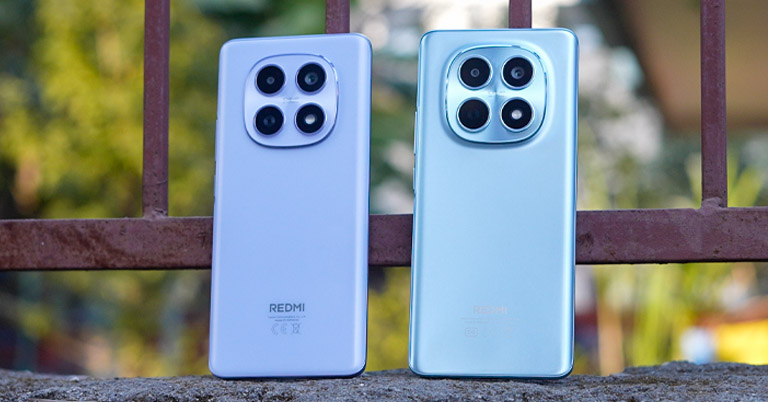
I’ll start with what both phones have in common. As the name suggests, the obvious difference is 4G versus 5G connectivity. Other than that, the design is almost identical.
From build quality to overall look and feel, both phones feel very similar in hand. I didn’t really notice much difference while holding them, and both models are available in some really nice color options. This year, Redmi has gone with a curved design, unlike last year, which makes both phones look more premium.
There is a small difference in durability. The Note 15 5G has an IP66 rating, while the Note 15 4G has an IP64 rating, indicating the 5G model offers slightly better water resistance. The 4G variant has a larger battery, so it is slightly heavier, but the difference is only about 5.7 grams, which is honestly negligible in real life.
Display
On the display side, I couldn’t really find any difference at all. Both phones come with the same size, resolution, and quality of display. You get a curved AMOLED panel with an in-display fingerprint sensor on both devices.
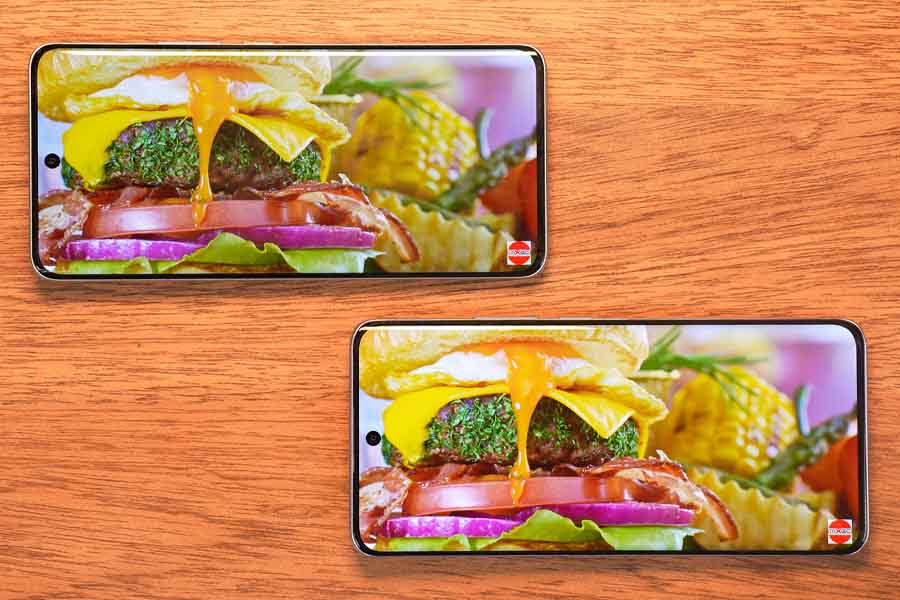
My overall display experience was very good. Neither phone supports HDR, which is something you usually get on Pro models, but the display is bright, colors look good, and content consumption is enjoyable.
Both phones also support a 120Hz refresh rate. I did notice occasional stutters, but most of the time, both phones felt smooth enough for daily use.
Speakers and Multimedia
One thing I genuinely liked about both phones is the speaker quality. Watching movies and listening to music felt quite enjoyable overall. Interestingly, I felt that the Redmi Note 15 4G has slightly louder speakers than the 5G variant. That said, both phones sound good enough for their price range, and I don’t really have any major complaints here.
Battery and Charging
Battery performance is another area where the two phones differ. The Redmi Note 15 4G comes with a 6000mAh battery, while the Redmi Note 15 5G has a 5520mAh battery. As expected, I got better battery life from the 4G variant. The 5G model easily lasts a full day, but the 4G variant gave me around one to two hours more screen-on time.
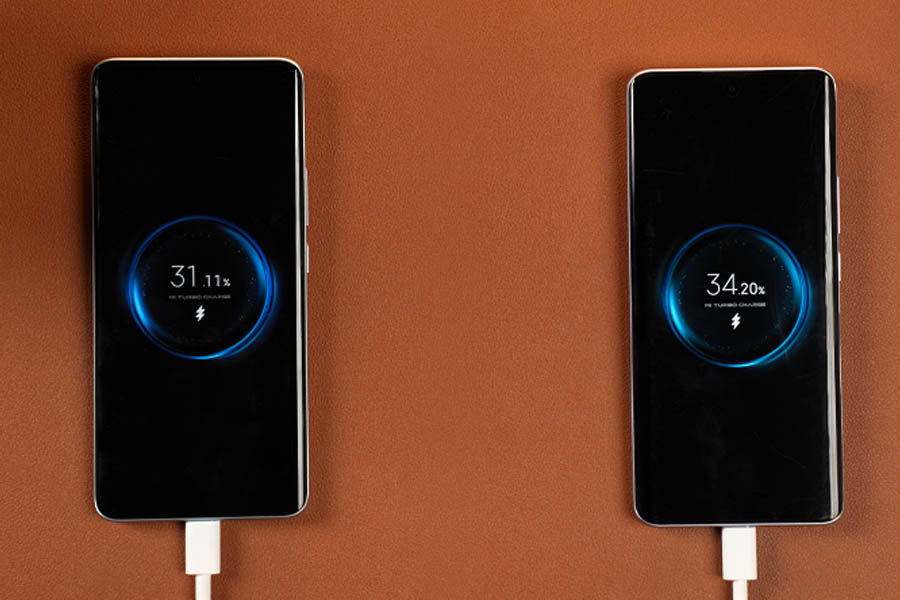
When it comes to charging, the 5G variant is faster. The 4G model supports 33W fast charging, while the 5G model supports 45W fast charging.
Performance
The biggest differences between the two phones are performance and camera, so let’s start with performance.
The Redmi Note 15 4G is powered by the Helio G100 Ultra chipset, which is not very different from the Helio G99 found in last year’s Note 14 4G. The Redmi Note 15 5G, on the other hand, comes with the Snapdragon 6 Gen 3, which is a more efficient 4nm chipset compared to the 6nm chip used in the 4G variant.
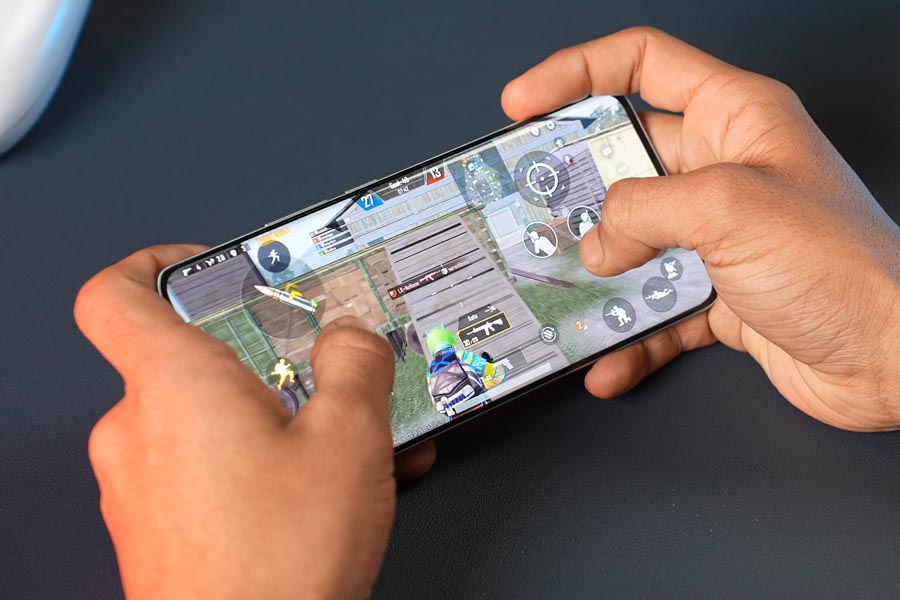
On paper, the 5G model should feel noticeably faster. However, in real-life day-to-day usage, I honestly didn’t feel a major difference. Apps opened at similar speeds, multitasking felt almost the same, and normal usage on the 4G variant never felt slow to me.
I tested the 8GB RAM variants of both phones. If you choose the 6GB version of the 4G model, you may notice some slowdowns when many apps are open.

In terms of gaming, I tested titles like Mobile Legends and PUBG on both phones. Both support up to 60 fps, and surprisingly, the 4G variant delivered slightly higher average FPS and lower 5th-percentile lows. This honestly surprised me. My guess is that the Helio G100 is better optimized since it has already been used in many devices. That said, I tested only the 8GB variants, so results may differ on the 6GB model.
Software
Both phones boot with Android 15 out of the box. While this is a bit disappointing, it was not unexpected, especially considering that even the more expensive Redmi Note 15 Pro Plus also ships with Android 15.
The good news is that Redmi has promised four years of software updates. Hopefully, updates will also arrive on time in Nepal.
Camera
Now let’s talk about the camera, and I’ll be very honest here. If camera performance is extremely important to you, neither of these phones is going to fully satisfy you.
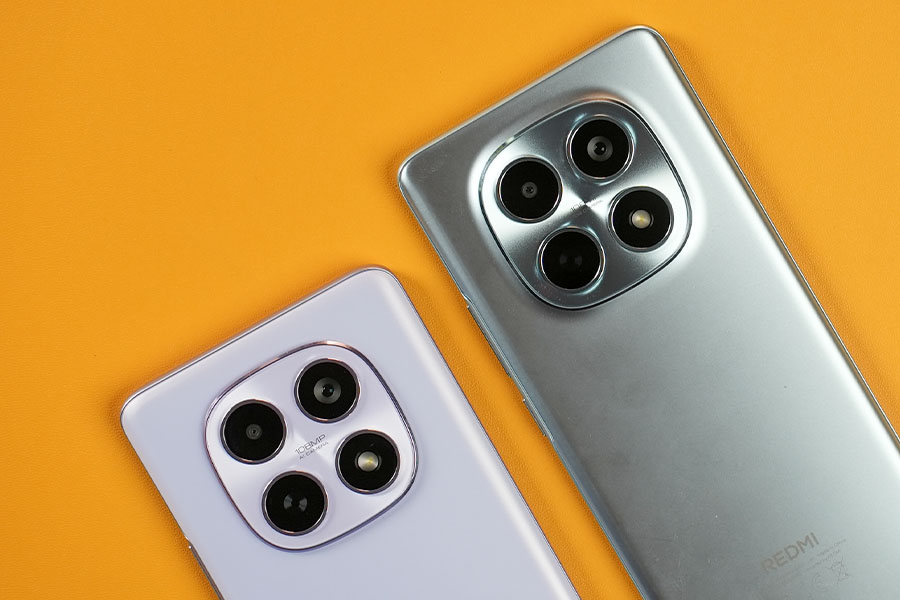
Both phones feature a 108MP main camera, and the 5G variant also includes an additional ultra-wide lens. While the 108MP sensor captures decent detail, everything else feels quite average. I was especially disappointed with the 5G variant’s exposure handling, which often felt inconsistent.
Daylight
In terms of colors, the 4G variant surprisingly produces slightly better results.
Night
Even though the 5G model has OIS, night photos come out soft and lack sharpness. It really feels like both phones urgently need camera-related software updates.
Portraits
Portrait shots are also underwhelming. On the 4G variant, my face looked almost like a painting, while the 5G model is slightly better but still far from impressive. Highlight handling could have been much better on both phones.
Selfies
Thankfully, selfies are decent on both devices. I personally preferred the skin tones from the 4G variant, but the 5G model also takes acceptable selfies.
Videos
Video recording is limited to 1080p on both phones. Videos can look a bit jittery, but for casual recording, they are fine. Selfie videos are also limited to 1080p, and I felt that the Note 15 5G handles skin tones slightly better in selfie videos.
Redmi Note 15 4G/5G Review: Conclusion
I’ve said this many times before, and I’ll say it again. With smartphone prices rising in 2026, new phones simply don’t offer the same value for money as they used to. The Redmi Note 15 4G and 5G are premium-looking smartphones that deliver a solid multimedia experience. Social media usage, video streaming, and everyday tasks work smoothly without major issues.

If that’s all you need, the 4G variant makes more sense to me. The performance difference between the 4G and 5G models is minimal; the camera on the 5G variant is not significantly better, and overall, the 4G version feels like the better value. That said, Redmi really needs to fix the camera performance through software updates on both phones.
Since neither of these phones is aimed at serious competitive gaming, I would suggest looking at the Infinix GT 30 if you want better gaming performance under NPR 40,000. And if camera quality is your top priority, the CMF Phone 2 Pro is a better option in my opinion.
That’s my honest take.
Redmi Note 15 4G/5G Review: Pros and Cons
Pros:
- Curved body
- Great display
- Good battery life

Cons:
- Average cameras
- Gaming is weak
Article Last updated: January 26, 2026

![Best Laptops to Buy in Nepal at Every Price Segment [Updated]](https://media.gadgetbytenepal.com/2025/11/Best-Laptops-to-Buy-in-Nepal-at-Every-Price-Segment-2025.jpg)