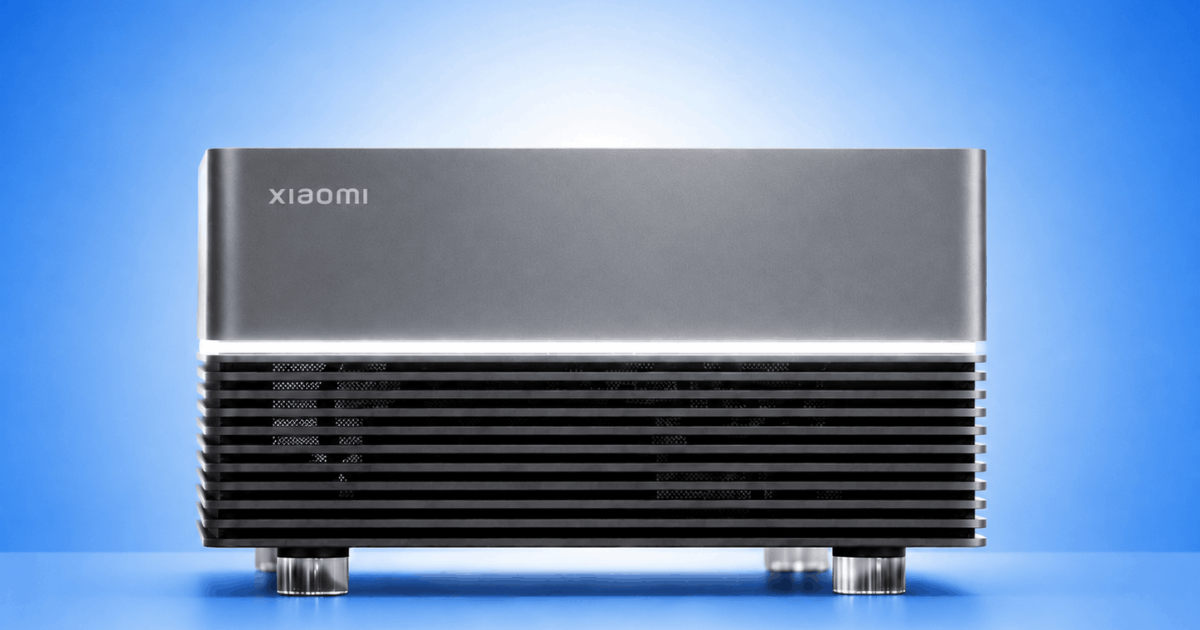
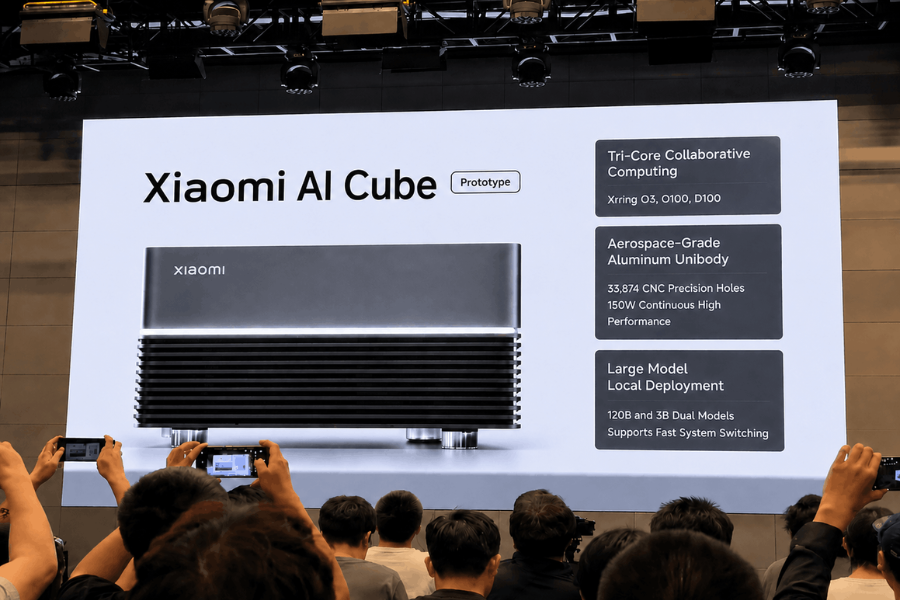
Xiaomi is expanding its in-house silicon beyond smartphones with a new mini PC focused on local AI processing. The company has unveiled the AI Cube Prototype, an engineering system that brings together three of its own chips—the Xring O3, Xring O100, and Xring D100—and can deliver up to 150W of sustained performance.
Key Highlights
- The Xiaomi AI Cube Prototype combines three Xring chips: O3, O100, and D100.
- It supports local deployment of 120B and 3B parameter AI models.
- Xiaomi claims up to 150W of sustained performance.
Rather than relying entirely on cloud-based AI services, the AI Cube is designed to run large AI models locally. Its three-chip architecture gives each processor a specific role, bringing general computing, AI acceleration, and high-compute processing together in one system. Let’s take a closer look at the Xiaomi AI Cube and what each of its Xring chips brings to the table.
Xiaomi AI Cube Overview
Design and Build
The Xiaomi AI Cube uses a compact mini-PC form factor with an aerospace-grade aluminum unibody chassis. Xiaomi has incorporated 33,874 precision CNC-milled ventilation holes throughout the enclosure to help manage heat during sustained workloads.
That cooling system is particularly important here, as the AI Cube is designed to maintain up to 150W of sustained performance. Unlike a conventional mini PC aimed at everyday computing, the system is built around demanding local AI workloads.
Three Xring Chips in One System
The biggest highlight of the AI Cube is its three-chip architecture. It combines the Xring O3, Xring O100, and Xring D100, with each chip handling a different part of the workload.
The Xring O3 serves as the primary processor. It features a 10-core CPU, 16-core G2-Ultra NX GPU, and 200 TOPS NPU, allowing it to handle general computing alongside graphics and AI acceleration.
The Xring O100 focuses on AI acceleration. It uses a 6nm 3D wafer-level stacked design and provides up to 1.22TB/s of near-memory computing bandwidth, helping the system process large AI models locally.
The third chip, the Xring D100, is designed for high-compute workloads. It features a 20-core CPU and 16-core NPU and supports up to 160GB of memory. Xiaomi has incorporated it into the AI Cube as another dedicated processing component for local AI workloads.
- You may also like:
Local AI Performance
The AI Cube is designed to run AI models locally, reducing the need to send workloads to the cloud. Xiaomi has demonstrated the system running 120-billion- and 3-billion-parameter models, with different system modes available depending on the workload.
The three-chip setup is what makes the prototype particularly interesting. Rather than relying on a single processor for everything, Xiaomi is distributing general computing, AI acceleration, and high-compute workloads across its own silicon.
Xiaomi AI Cube Specifications
- Design, build: Aerospace-grade aluminum unibody chassis with 33,874 CNC precision perforations
- Processor: Xiaomi Xring O3, 10-core CPU
- GPU: 16-core G2-Ultra NX GPU
- NPU: 200 TOPS
- AI chips: Xring O100 and Xring D100
- Xring O100: 6nm 3D wafer-level stacked design, up to 1.22TB/s near-memory computing bandwidth
- Xring D100: 3nm process, 20-core CPU, 16-core NPU
- Memory: Up to 160GB
- AI model support: Local deployment of models with up to 200 billion parameters
- Performance: Up to 150W sustained performance
- Demonstrated models: 120B and 3B parameter models
Xiaomi AI Cube Price and Availability
The Xiaomi AI Cube is currently an engineering prototype, rather than a commercially available mini PC. Xiaomi has not announced its price or a consumer release date yet.
It also remains unclear whether the company plans to bring the AI Cube to market or use it primarily as a showcase for its growing in-house silicon ecosystem.
For now, the prototype gives Xiaomi an interesting demonstration of what its Xring platform can do beyond smartphones, combining the Xring O3, O100, and D100 in a single system designed for local AI processing.
Article Last updated: August 25, 2026

![Best Flagship Smartphones To Buy In Nepal [Updated 2026]](https://media.gadgetbytenepal.com/2026/04/Best-flagship-smartphones-to-buy-in-Nepal-2026.jpg)