The government has dropped the smart chip in favor of an Intelligent QR system that works offline, meets international standards, and is being printed entirely in Nepal for the first time.
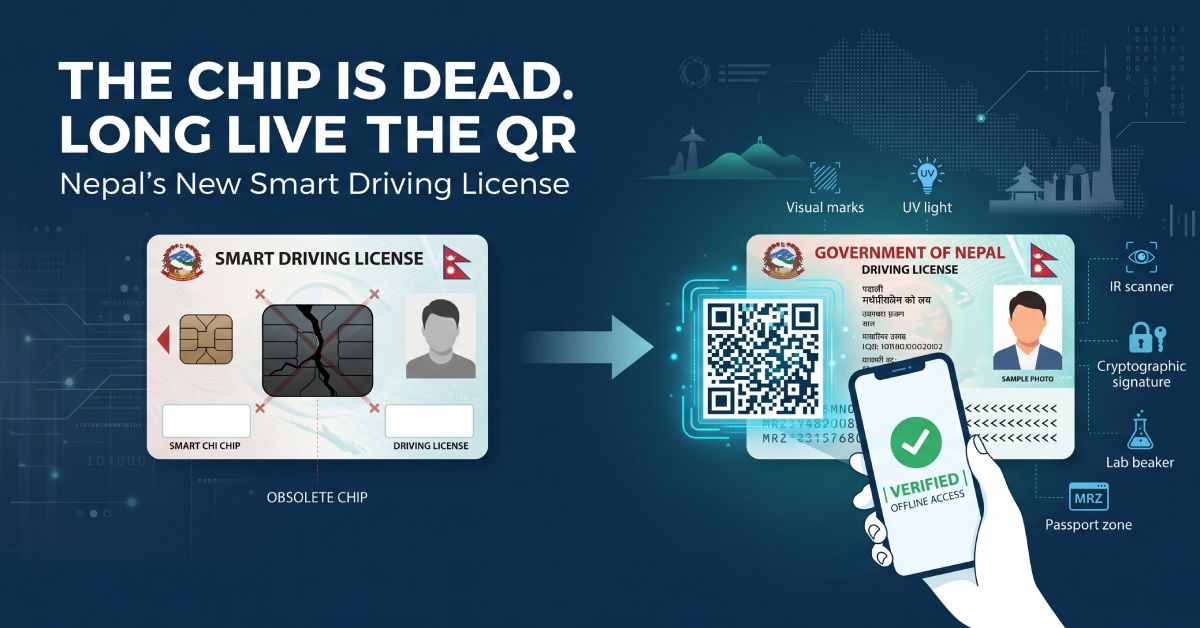
For years, a smart driving license has been one of Nepal's biggest embarrassments. The cards existed. The chips inside them worked. But the card readers needed to actually verify them somehow never made it to the traffic police who needed them, despite the government receiving 200 of them through an Asian Development Bank program back in 2022. The result: a smart card system that wasn't really smart.
That chapter is now officially closing. The Ministry of Communications and Information Technology has confirmed that a new generation of smart driving licenses is now being printed at the Security Printing Center in Panauti Municipality-5, Kavre. This time built around Intelligent QR (I-QR) technology, an international ID standard, and a production pipeline that stays entirely inside Nepal.
What I-QR Actually Does
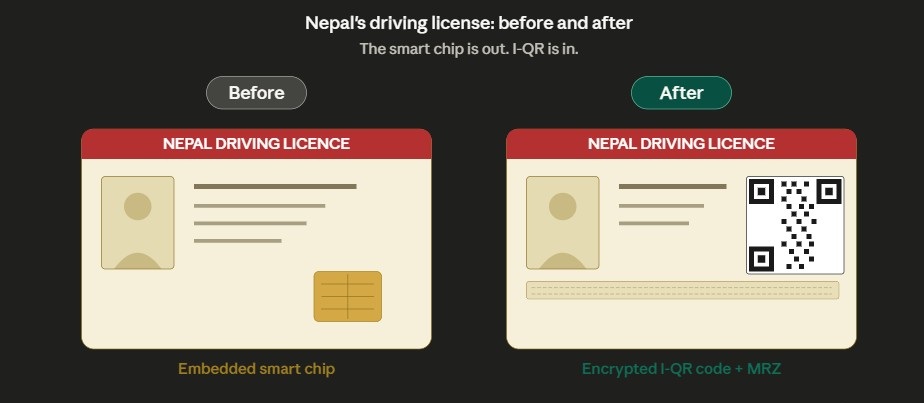
Instead of embedded chips, the new license uses an encrypted, multi-layered, copy-protected QR code. One clear advantage of this system is offline verification. Traffic police and other authorized agencies can scan the card and instantly confirm a driver’s identity, even in areas with no internet access.
That also makes the smartphone the primary verification tool, instead of a specialized card reader that may not be available at every checkpoint across Nepal.
The ministry has also pointed to two other reasons for the pivot away from chips. No.1: the lack of domestic infrastructure to make full use of smart chips, and No. 2: the risk of relying on foreign experts to maintain the system.
The Chip is Dead. Long Live the QR.
New Card Built to International Standards
The new card is printed to the ISO 7810 ID-1 specification, the same global standard used for credit cards and most national IDs. The ministry has also listed 39 separate security features across three tiers:
Level 1: Naked-Eye Features
These are the first line of defense, meant to catch obvious fakes with a quick visual check.
- Metallic silver ink visible without any equipment
- Machine-Readable Zone (MRZ): the same encoded text strip used on international passports
Level 2: Specialized Equipment Required
This layer is designed for checkpoints and verification booths equipped with UV or IR tools: the kind of inspection that catches higher-effort counterfeits.
- Invisible UV ink is revealed only under ultraviolet light
- Infrared absorption features are readable only by specific scanners
Level 3: The Forensic Layer
This is deep-inspection territory. According to the ministry, every card is cryptographically unique, meaning even a visually identical fake would fail a lab test. It's the same layered defense philosophy used for modern passports and banknotes: visual checks, equipment checks, and forensic checks, each harder to defeat than the last.
- Digital signatures for cryptographic authenticity checks
- Proprietary electro-ink that can only be verified in a laboratory
Also Read: How to Check Your Smart Card License Status
Why the New System Is Safer and Cheaper
The ministry says the entire production process is end-to-end offline. No cloud sync, no external servers, no third-party data processing. The claim is that this eliminates realistic pathways for data leaks or unauthorized access to citizens' personal information. The QR code also remains valid for the full lifetime of the card.
The ministry also says the new system is much cheaper than chip-based cards, and because production is domestic, citizens' data never leaves the country.
Old vs New Smart Driving License in Nepal: Key Differences
| Aspect | Old Smart License | New Smart License |
| License type | Embedded smart chip | I-QR + MRZ |
| Verification | Dedicated card reader required | Can be scanned with a smartphone |
| Internet needed? | Not practical due to hardware dependency | No, works fully offline |
| Security level | Basic anti-forgery features | 39 features across 3 layers |
| Security note | Visible elements only; easier to fake | UV ink, MRZ, digital signatures, electro-ink |
| Where it is produced | Imported system with foreign dependence | Printed in Nepal |
| Data handling | Relied on outside vendors | End-to-end offline inside Nepal |
| Delivery timeline | Months to years of waiting | 24 hours after trial fee paid |
I-QR May Soon Power More Official Documents
The Security Printing Center isn't being built just for driver's licenses. Under the government's plan, the same I-QR system will eventually handle Citizenship certificates, Excise duty stickers, Land ownership certificates (Lalpurja), Visa stickers, and University certificates.
Initial Thoughts
The new QR-based smart license looks like a much better fit for Nepal. A QR code that works on any smartphone is clearly more practical than a chip that needs special hardware. Offline verification is also a big advantage, especially in places with weak internet. And while the 39 security features sound impressive, the real test will be how well the system holds up once these cards are used widely.
Likewise, Nepal has a long track record of strong announcements followed by weak delivery on distribution, officer training, and inter-department coordination. As of now, scanning the QR on the new card reportedly returns only the license number. Full integration with Nepal Police and traffic databases, however, remains to be seen.
Still, for the first time in a long time, the plan feels grounded in what Nepal can actually build. A proper, credit-card-sized smart license may finally be on the way. About time.
Article Last updated: April 21, 2026