The Galaxy S26 Ultra is available, bringing a thinner body, refined cameras, faster charging, and Samsung’s new Privacy Display tech.
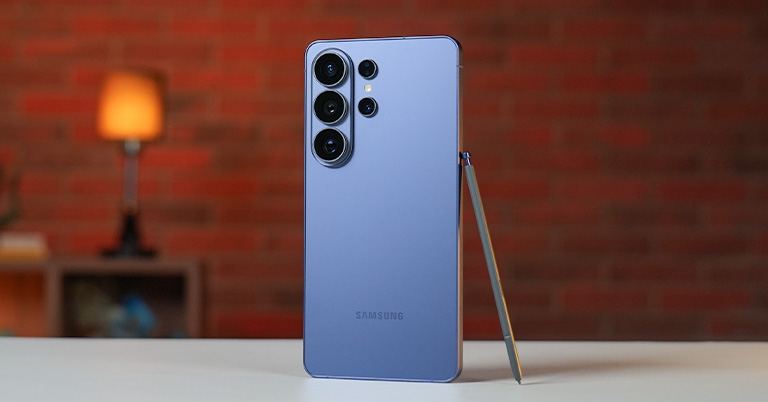
Samsung's Galaxy Unpacked on February 25 brought exactly what most people expected and maybe a little more. The Galaxy S26 Ultra is officially here in Nepal, and while it doesn't make any significant leap in its refresh, there's a strong case to be made that this is the most well-rounded Ultra Samsung has ever shipped. A slimmer body, genuinely improved cameras, faster charging, and one legitimately exciting new display trick. But whether that's enough to get excited about? That depends a lot on what you were hoping for. Let’s dive into this article to discuss everything about the latest Samsung Galaxy S26 Ultra, including its specifications, official availability, and expected price in Nepal.
Samsung Galaxy S26 Ultra Price in Nepal and Availability
The Samsung Galaxy S26 Ultra price in Nepal begins at 212,999 for the 12/256GB base version. It is now officially available for prebooking in Nepal with NPR 10,000 off on the 12/256GB trim and NPR 15,000 off on the 12/512GB and 16GB/1TB variants. Samsung is also offering 1 year of breakage insurance, and deliveries to customers will start after March 13th.
| Samsung Galaxy S26 Ultra | Price in Nepal (Official) | Pre-booking Price |
|---|---|---|
| 12GB + 256GB | NPR 212,999 | NPR 202,999 |
| 12GB + 512GB | NPR 242,999 | NPR 227,999 |
| 16GB + 1TB | NPR 293,999 | NPR 278,999 |
Samsung Galaxy S26 Ultra Overview
Design
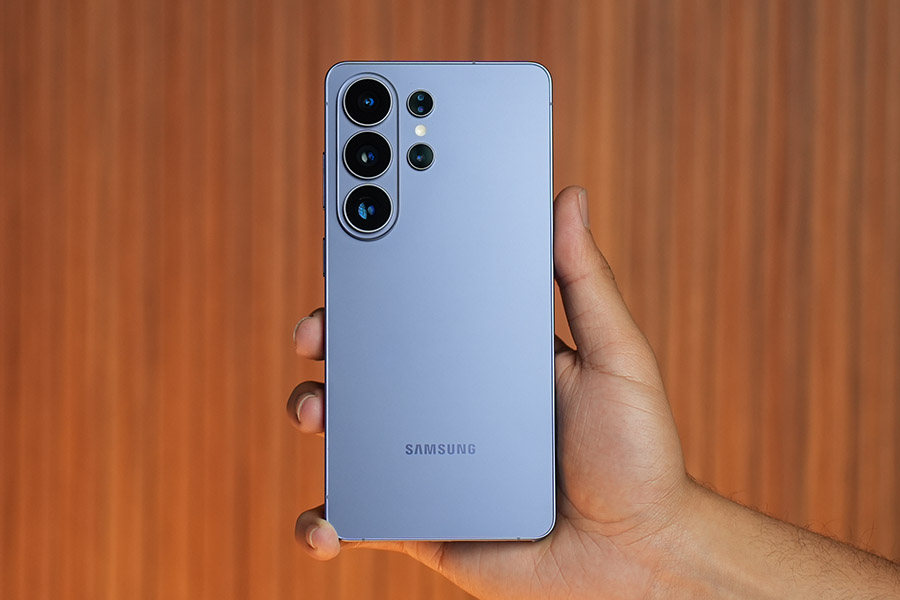
Let's start with how the phone actually feels, because that's where the first impression often lands the hardest. The S26 Ultra is Samsung's thinnest and lightest Ultra ever. We are talking about 7.9mm thick and 214 grams, shaving off about 0.3mm and roughly 4 grams compared to last year. In isolation, that sounds trivial, but when you actually hold it, there's a noticeable difference.
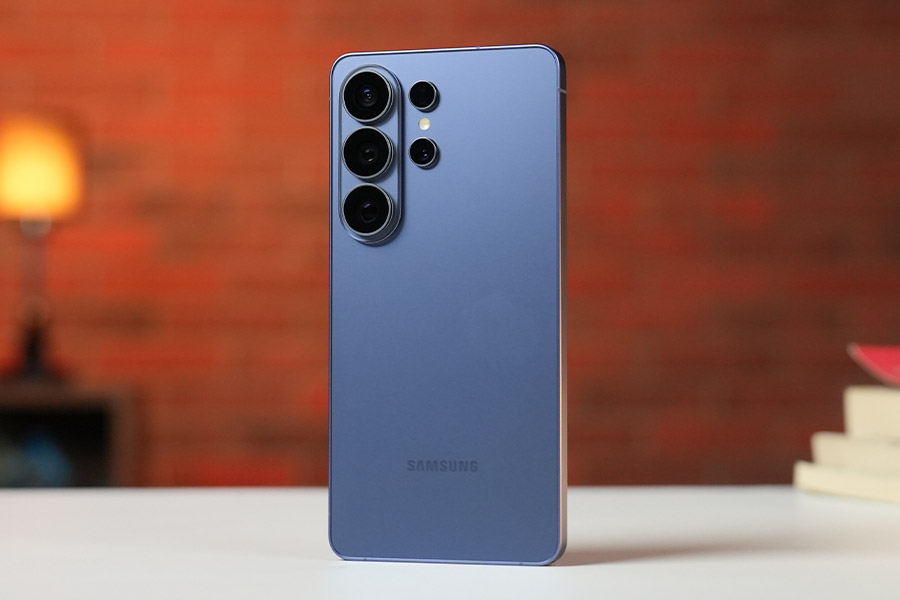
The corners are softer and more rounded, the sides curve more gently into the frame, and the overall silhouette now matches the design language of the S26 and S26 Plus, which is something Samsung should have done years ago, frankly. The entire lineup finally feels like it belongs to the same family, rather than the Ultra existing as a bulky outlier on its own.
One trade-off worth flagging is that Samsung, like Apple, ditched titanium in favor of Armor Aluminum. After spending the better part of the last couple of years marketing titanium as a premium feature, quietly dropping it feels a little awkward. That said, aluminum may actually help with thermals, and paired with the thinner profile. The back is Gorilla Glass Victus 2, the front gets Corning Gorilla Armor 2, and IP68 is on board as expected. Colors this year include Cobalt Violet, Sky Blue, Black, and White, which are a bit on the safe side.
Display
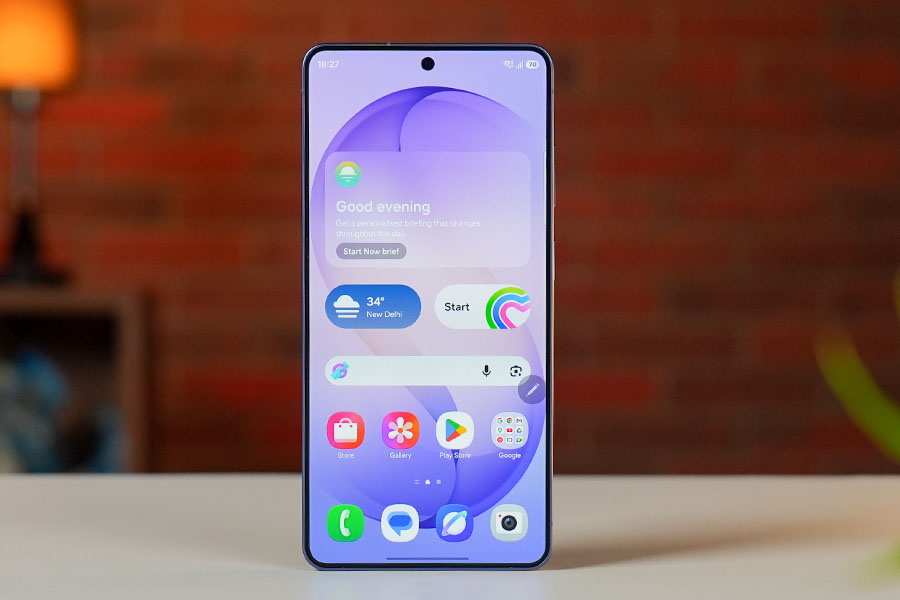
Now, on the display side. The S26 Ultra's 6.9-inch QHD+ Dynamic AMOLED 2X panel with 1–120Hz adaptive refresh and up to 2,600 nits of peak brightness is, on paper, what you'd expect from a flagship in 2026. But there's something genuinely new here, the Privacy Display.
What is Privacy Display?
This is the headline feature, and it's worth spending some time on it because it's definitely not a gimmick, something that was on the rumor pages for a while; however, it's also not without compromise. Rather than slapping a privacy screen protector over the display, Samsung has built this into the hardware at a pixel level. The display uses two types of pixels, wide-firing ones for normal viewing angles, and narrow-firing ones that beam light almost directly forward. Toggle Privacy Display on, and the wide pixels effectively switch off, leaving only the narrow ones active. The result you get is that what's on your screen essentially disappears to anyone not looking at it head-on.
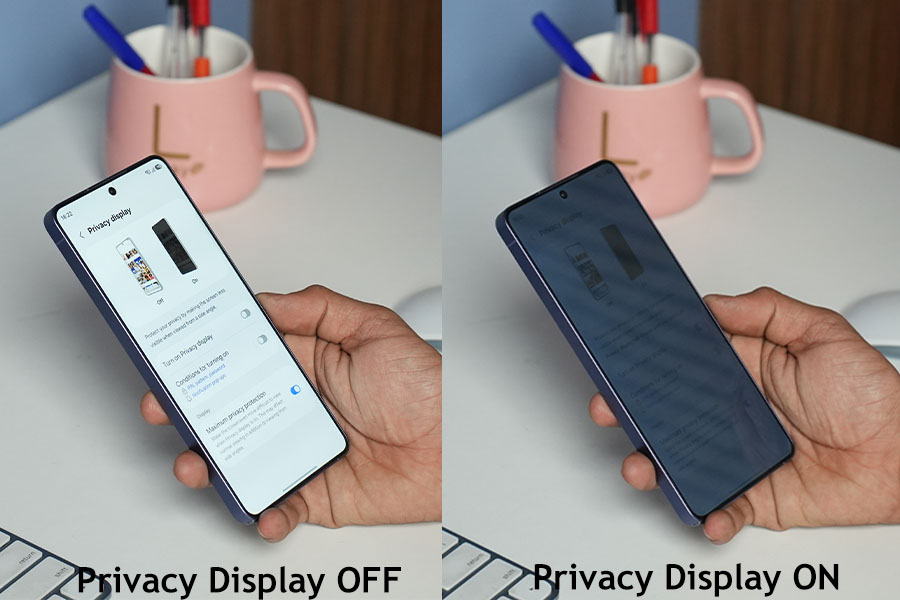
One thing I find to be genuinely clever is the level of control. You can set it to activate for specific apps, just on your lock screen for PIN entry, or even isolate it to just your notification pop-ups while keeping the rest of the screen fully visible to others. It works in both portrait and landscape. And, the first time you see it in action, it do feels a little like magic.
Now, as I said, there are some real concerns. Because Privacy Display essentially halves the active pixels, brightness, and resolution take a visible hit when it's enabled across the full screen. That's an acceptable trade-off in, say, a crowded subway or an open-plan office. But it's a trade-off nonetheless. More interestingly, even with Privacy Display completely turned off, the S26 Ultra's viewing angles appear noticeably worse than the S25 Ultra. There’s a blue tint that kicks in as you rotate the phone, and brightness falls off faster.
That's almost certainly a side effect of having a portion of pixels permanently tuned to fire light in a narrower cone. I think it's not a dealbreaker for straight-on use, and when you are looking straight at it, the display is a step up, especially with the new 10-bit panel support (up from 8-bit) and Samsung's ProScaler doing real work in the background to sharpen and upscale content. But one would definitely want more time with this before calling Privacy Display a clear win for everyone.
Chipset and Performance
The Snapdragon 8 Elite Gen 5 for Galaxy powers the S26 Ultra globally. On the non-Ultra S26 and S26 Plus, Samsung is using Exynos 2600 in most regions outside North America, China, and Japan.
Samsung's custom "for Galaxy" tuning delivers roughly 19% faster CPU performance, 24% stronger GPU output with ray tracing support, and a 39% jump in NPU performance for AI tasks. The vapor chamber has been redesigned to handle the slimmer chassis, and Samsung claims 21% better thermal dissipation. Compared to something like the Tensor G5 in Google's latest Pixels, the Snapdragon is in a different class for raw benchmarks and gaming, though Pixels still hold their own in computational photography and real-world feel.
Similarly, RAM starts at 12GB across the 256GB and 512GB configurations, with 16GB reserved for the 1TB top-spec model. Storage starts at 256GB across the whole S26 lineup this year. Another welcome change is the fact that Samsung has quietly dropped the 128GB base option.
Cameras
The camera specs look almost identical to last year's. Same sensor count, same megapixel figures on most lenses. But there are changes in the apertures, and it affects your pictures a lot. . The 200MP main wide-angle now opens to f/1.4, up from f/1.7 on the S25 Ultra, which Samsung claims is about 47% more light intake. The 50MP 5x periscope telephoto moves from f/3.4 to f/2.9, bringing roughly 37% more brightness to long-range shots. The 50MP ultrawide and 10MP 3x telephoto remain largely unchanged. Up front, the 12MP selfie camera benefits from an upgraded AI ISP.
In practice, the low-light gains are the most compelling thing here. Nighttime video in particular sees meaningful noise reduction, and the face processing improvements produce results that appear much better than the occasionally over-smoothed output of older Galaxy cameras. There's also a new Anti-Flare lens coating across the camera array to reduce those starburst artifacts that plagued previous generations.
Super Steady Video mode
Another interesting camera feature is the Horizontal Lock in Super Steady mode. This uses real-time gyroscope and accelerometer data to correct up to 360° of rotational movement in video. Trying it while deliberately overcorrecting in every direction and still ending up with stable, watchable footage is pretty remarkable. Other than that, new this year is support for the APV video codec, which is designed to maintain high quality across repeated edits.
But does all of this put Samsung at the top of the camera hierarchy? Honestly, probably not quite. Google's computational photography pipeline still punches above its weight on a per-shot basis, especially for point-and-shoot scenarios. But Samsung's hardware improvements seem to have closed the gap meaningfully, and the sheer versatility of having four distinct focal lengths, including a genuinely bright 5x periscope, is another welcome move.
Battery and Charging
The battery stays at 5,000mAh, unchanged from the S25 Ultra and, for that matter, the S24 Ultra. This has just been a ceiling that Samsung isn't willing to push through, especially when foldables and competitors are shipping silicon-carbon cells with significantly higher capacities in slimmer bodies. Samsung argues that efficiency gains from the new chipset extend real-world endurance, which they claim up to 31 hours of video playback, about five hours more than last year.
Anyway, where Samsung does move forward meaningfully is in charging. The S26 Ultra now supports 60W wired charging, which is the fastest ever on a Galaxy Ultra, hitting 75% from flat in about 30 minutes. Wireless charging also steps up to 25W as well (from 15W on the S25 Ultra). Reverse wireless charging is available at 4.5W.
One thing that continues to be a head-scratcher is that there are still no built-in magnets for Qi 2 wireless charging. Samsung says the decision is intentional to keep the device slim, which is also probably fair, but for the price it comes, I don’t think the expectation is unfair either.
Software and Galaxy AI
The S26 Ultra ships with One UI 8.5 on top of Android 16, with seven years of OS and security updates promised. Galaxy AI has matured noticeably this year. Now Nudge is probably the most practically useful new addition they have introduced this year. it surfaces contextual suggestions based on what's on your screen.
Someone texts asking for photos from your last trip will result in a prompt appearing with relevant Gallery images already pulled. And when someone asks if you're free Saturday, your Calendar info automatically appears. It works across Samsung Messages, Google Messages, and WhatsApp. The consistency remains to be known, but the concept is still solid, and it mirrors what Google is doing with Magic Cue on Pixel devices.
Photo Assist now supports natural language editing directly in Gallery, where you can type a prompt to change a background, add an object, or modify the scene, and it handles it with noticeably fewer artifacts than earlier Galaxy AI editing tools. Similarly, there’s the Creative Studio that lets you generate stickers, cards, and wallpapers from photos or rough sketches. And Audio Eraser now works inside third-party apps like YouTube and Netflix as well. The Call Screening feature is new to Galaxy, and it is similar in concept to what Pixel has offered for a while.
Bixby has been upgraded to an LLM-based conversational agent with Gemini and Perplexity integration. Gemini can handle multi-step background tasks, like booking an Uber while you keep using your phone, with Samsung promising expansion to apps like Instacart and DoorDash down the line.
Also, read
S Pen
The S Pen is still here, still built-in, and that continues to be one of the S26 Ultra's strongest differentiators in 2026, especially when you look at what else is out there at this price. The iPhone 17 Pro Max doesn't have a stylus, and the Pixels never had it either.
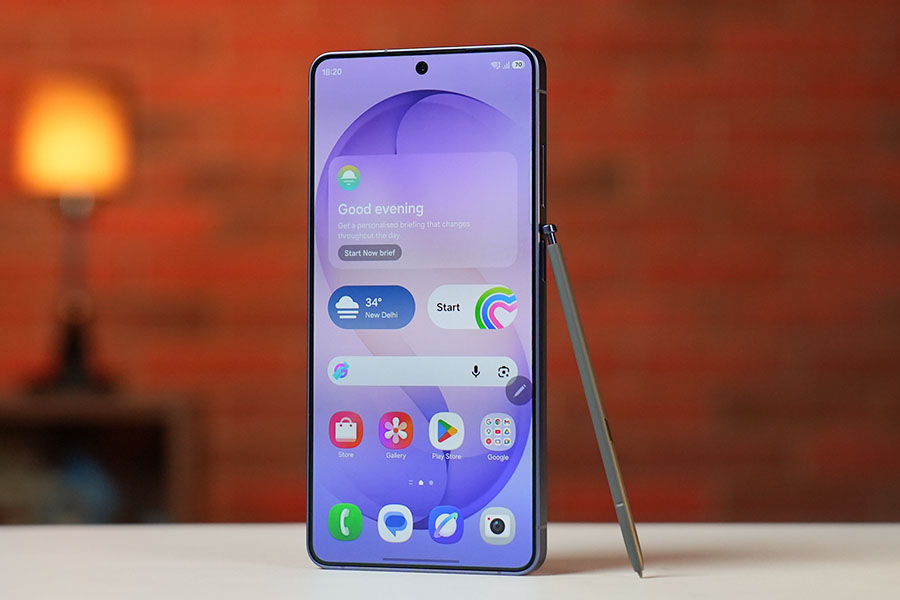
The tip has been subtly redesigned with a slight curve to better match the Ultra's newly rounded display corners. What hasn't returned, for the second year running, is Bluetooth support, so any remote shutter or presentation-clicker functionality that the S Pen used to offer is still gone.
Connectivity and Security
On connectivity, the S26 Ultra covers all the bases you'd expect at this level: 5G, Wi-Fi 7, Bluetooth 6.0, NFC, and USB-C. GPS covers the full suite: GPS, GLONASS, Galileo, BDS, and QZSS. On the audio side, the S26 Ultra continues with stereo speakers tuned in collaboration with Dolby.
Biometrics on the S26 Ultra are handled by an ultrasonic in-display fingerprint scanner and face unlock. The ultrasonic scanner has been Samsung's approach for several generations now, and it remains one of the better implementations of in-display fingerprint technology available. Face unlock is also convenient for quick access, but, as with most face unlock implementations on Android, it's not as secure as the fingerprint scanner for things like payments. Samsung Knox Vault handles the storage and on-device processing of sensitive datafor AI-related security.
Samsung Galaxy S26 Ultra Specifications
- Design, build: 163.6 × 78.1 × 7.9 mm, 214g, Armor Aluminum frame, Gorilla Glass Victus 2 back, Gorilla Armor 2 front, IP68
- Display: 6.9-inch QHD+ Dynamic AMOLED 2X, 3120 × 1440, 1–120Hz adaptive, up to 2,600 nits peak, 10-bit, Privacy Display, ProScaler, anti-reflective coating
- Chipset: Qualcomm Snapdragon 8 Elite Gen 5 for Galaxy (3nm), Adreno GPU
- Memory: 12GB RAM / 256GB; 12GB RAM / 512GB; 16GB RAM / 1TB (UFS 4.0, non-expandable)
- Software & UI: One UI 8.5 on Android 16, 7 years of OS and security updates
- Rear Camera: 200MP f/1.4 wide (OIS) + 50MP f/1.9 ultrawide + 10MP f/2.4 3x telephoto + 50MP f/2.9 5x periscope telephoto (OIS), Anti-Flare lens coating, APV video codec, Horizontal Lock Super Steady
- Front Camera: 12MP f/2.2, 4K video, upgraded AI ISP
- Security: Ultrasonic in-display fingerprint scanner, Face Unlock, Samsung Knox Vault
- Connectivity: 5G, Wi-Fi 7, Bluetooth 6.0, NFC, USB-C, GPS / GLONASS / Galileo / BDS / QZSS
- Sensors: Accelerometer, Barometer, Gyroscope, Geomagnetic, Hall, Proximity, Grip
- Battery: 5,000mAh with 60W wired (0–75% in ~30 min), 25W wireless, 4.5W reverse wireless, Qi 2.2 (via compatible case)
Should you buy the Samsung Galaxy S26 Ultra in Nepal?
The Samsung Galaxy S26 Ultra is already up for preorder at a starting price of around NPR 212,999 (NPR 202,999 with prebooking discount) for the 12GB/256GB variant. The honest answer to whether it’s worth it still depends on what you're upgrading from. If you're on a Samsung Galaxy S23 Ultra or older, this is a meaningful upgrade across the board — cameras, performance, charging, and the Privacy Display as a genuine bonus. The latter works pretty well, though it does affect overall screen sharpness in our testing. So, if you're on a Samsung Galaxy S25 Ultra and it’s still in good shape, the jump is harder to justify unless the Privacy Display or faster charging specifically matter to you.
For Nepal specifically, at a starting price of about NPR 212,999, it clearly sits in the ultra-premium segment. You’d want to be sure this is the form factor and ecosystem you’re committed to. That said, for power users, content creators, or anyone who genuinely uses the S Pen, there still isn’t really another Android phone at this price that does everything the S26 Ultra does.
Frequently Asked Questions
- Meanwhile, check out our review of the Samsung Galaxy S25 Ultra
Article Last updated: March 19, 2026
![Asus Vivobook 15 (2023) Price in Nepal [Updated]](https://media.gadgetbytenepal.com/2025/04/Asus-Vivobook-15-2023-Price-in-Nepal.jpg)