If you're new to drones and looking for an easy way to register your drone and get a permit, this is the perfect guide for you!
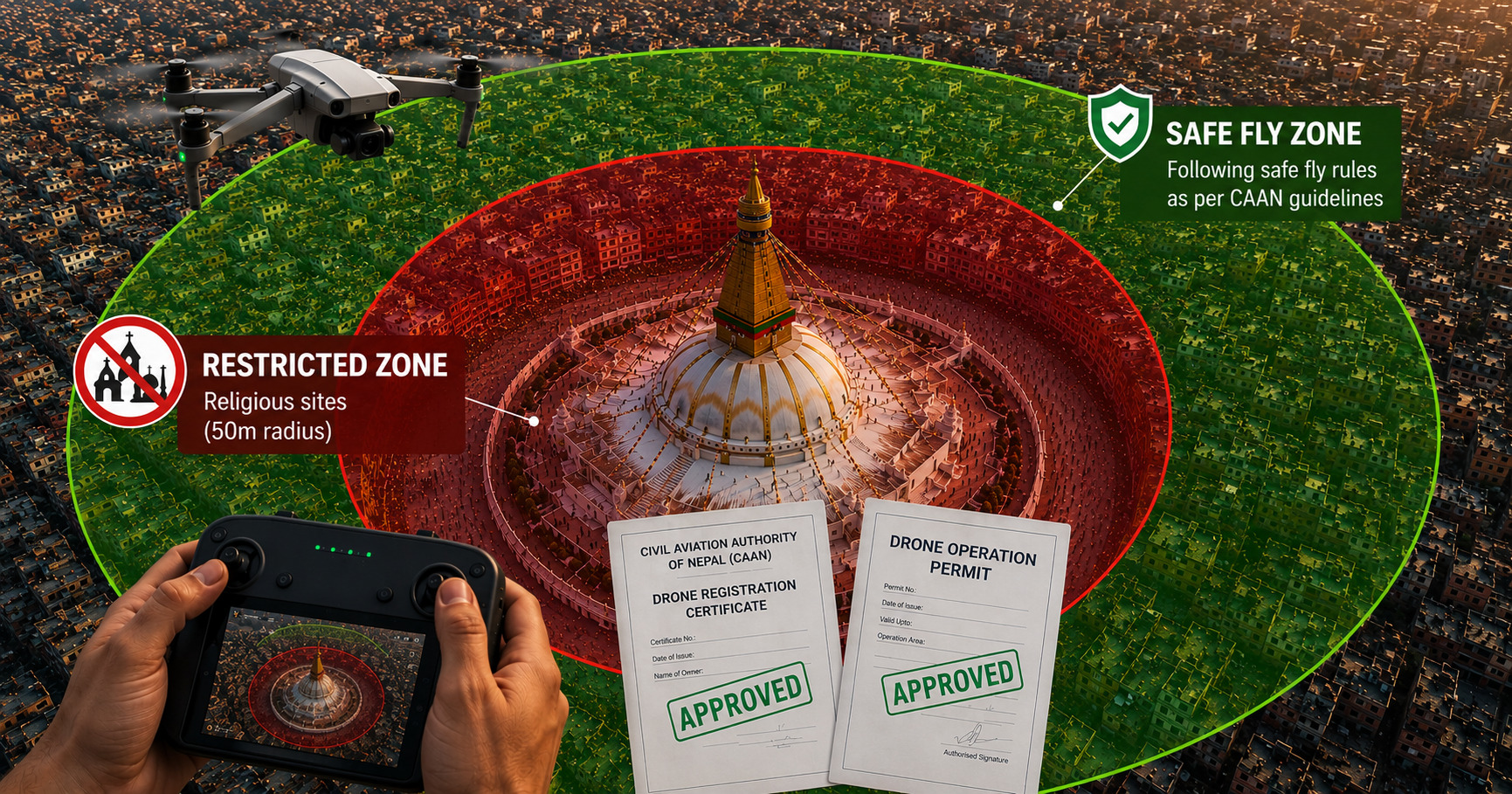
Flying a drone in Nepal is not as simple as unboxing and taking off. CAAN (Civil Aviation Authority of Nepal) has its own set of rules, and if you skip any step, you could end up with a confiscated drone or worse. So, in this article, I will walk you through everything from registering your drone to obtaining your desired permit.
Drone Regulations in Nepal
Can You Bring a Drone to Nepal from Abroad?
Short answer: Yes, you can. Whether you are a foreign tourist or someone returning to Nepal after a long time, you can bring a drone. But you need to go through the proper channels before you can fly it. Depending on your situation, you will be dealing with one or more of these offices:
- Civil Aviation Authority of Nepal (CAAN): drone registration and flight permits
- Local Government or CDO Office: local security approval
- Ministry of Home Affairs: security clearance for foreign nationals
- Department of National Parks and Wildlife Conservation: if you are heading to Everest, Manaslu, or Annapurna
Drone Category in Nepal as per CAAN
CAAN put drones into four categories based on how heavy they are at maximum take-off weight:
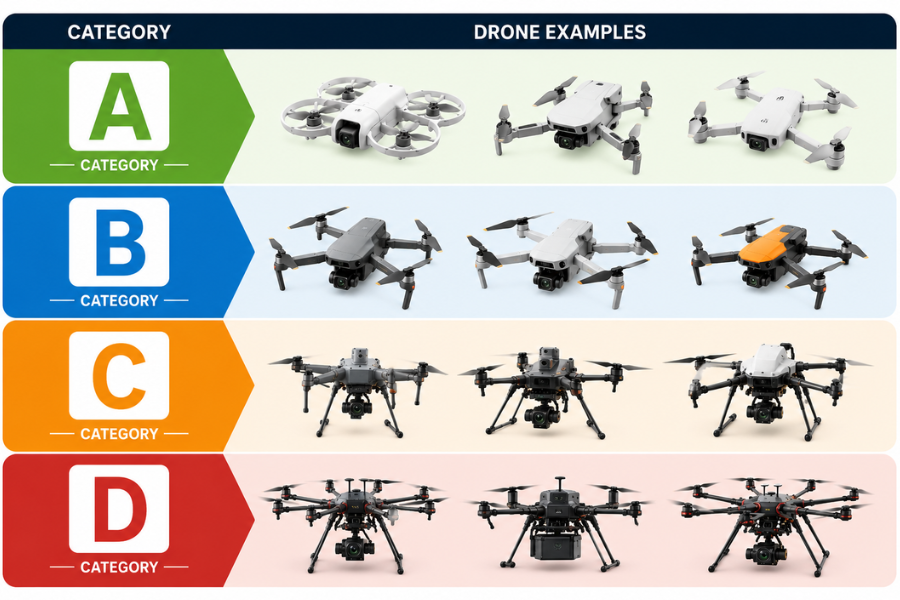
| Category | Risk Level | Weight (MTOW) |
| A | Very Low Risk | Under 250g |
| B | Low Risk | 250g to 2 kg |
| C | Regulated Low Risk | 2 kg to 25 kg |
| D | Regulated High Risk | Above 25 kg |
Most consumer drones, such as the DJI Mini series, fall under Category A or B. Heavier cinema or industrial drones go into C or D, and those come with much stricter oversight.
How to Register Your Drone in Nepal
Before you can legally fly, you need to register your drone with CAAN. Once that is done, CAAN assigns you a Unique Identification Number (UIN).
There are two ways to register:
- Through the CAAN online portal
- Visiting the office to submit a paper form.
For online registration, visit the CAAN official website and fill in the information.
Whereas, if you want to register offline, you need to visit the Flight Safety Standard Department (FSSD), along with your drone and all of the following documents:
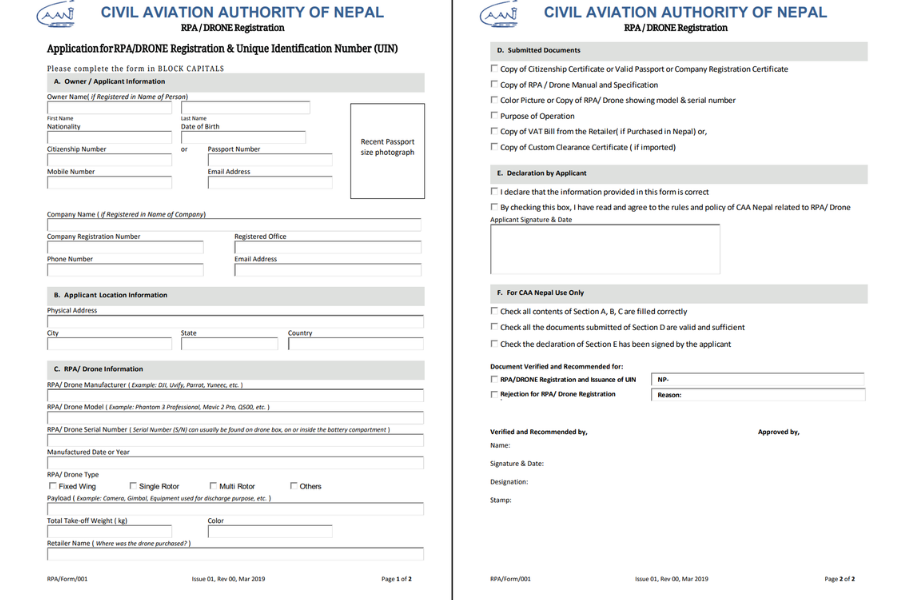
- Filled-out drone registration form (RPA/Form/001)
- Purpose of Operation and Commitment Letter (RPA/Form/002)
- Passport-size color photograph of the applicant
- Copy of your citizenship certificate, valid passport, or company registration certificate
- Copy of the drone’s manual or spec sheet
- Photo of your drone showing the serial number clearly
- VAT bill from the retailer if you bought it in Nepal, or TIA customs declaration if you imported it
- Customs Clearance Certificate for imported drones
The registration fee is USD 50 plus 13% VAT, paid to Rastriya Banijya Bank (TIA Branch) via bank deposit or Connect IPS. If your documents check out, you get your UIN certificate within 2 to 3 working days. Note that the registration certificate is valid for one year and must be renewed annually.
Additionally, two more requirements apply: your drone must have a CE marking or a type of approval certificate, and if your drone falls under Category C or D (above 2 kg), you must bring the drone itself to FSSD for physical verification when collecting your registration certificate. Valid insurance is also mandatory for Category C and D drones.
You can download the required documents here:
Drone Registration File:
- Documents required for UAV/Drone Online Registration (Nepalese)
- Documents required for UAV/Drone Online Registration (Foreigners)
Application Forms:
- RPA/Form/002- Purpose of Operation and Commitment Letter
- RPA/Drone/Paragliding Flight Permission Application
Drone Permit Rules for Nepal
Operating a drone in Nepal without the required permits is illegal. However, with the proper paperwork in place, you can legally fly. CAAN has issued specific rules that all operators must follow.
Getting a permit as a Nepali is fairly easy compared to foreign citizens or travelers. You submit your purpose of use, a flight plan, and proof of insurance to CAAN. They review it and, if approved, give you a permit with specific restrictions and an expiry date.
One extra thing, depending on your drone size:
- Drone under 2 kg: get permission from the District Administration Office (DAO) covering the area where you plan to fly
- Drone above 2 kg: get permission from the Ministry of Home Affairs and the Department of Information
After the permit, you need to:
Send a formal application to the Ministry of Communication and Information Technology
This letter goes on your company’s letterhead/(if individual normal letter) and needs to cover:
- Your drone’s name and UIN number
- The exact dates you plan to use it, plus a statement that you will follow all CAAN rules
- Pilot’s full name, nationality, and citizenship or national ID number
- A detailed flight plan with GPS coordinates, dates, and altitudes
- A map of your intended flight routes
Along with the letter, also include these documents:
- Project synopsis
- Your itinerary
- Temporary drone registration
- Filming crew details with passport copies
- Equipment list
- An authorization letter from the local government
- PAN card, company registration certificate, and tax clearance
- Company Owner Citizenship
Once you have everything together, pick up the permit form from the ministry and submit it all at once. If approved, you get a 3-month permit. If you need more time and have a good reason, a 3-month extension is also possible.
Permit Requirement for Conservation Area
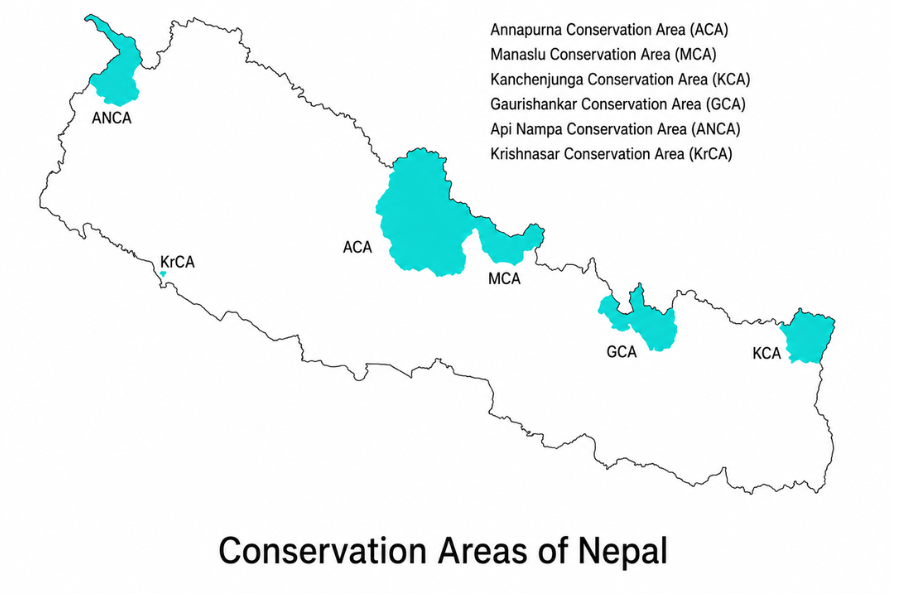
Getting a drone permit doesn't automatically mean you can fly anywhere. The standard permit covers non-restricted areas. To fly in a conservation area, you need to go through additional steps.
okey lets go to each steps one by one by one:
Step 1: Visit the National Trust for Nature Conservation (NTNC)
Submit a letter to the NTNC that includes your:
- Drone name and UIN number
- Planned flight dates + a statement confirming you will follow all CAAN rules
- Pilot's full name, nationality, and citizenship/national ID number
- Detailed flight plan with GPS coordinates, dates, and altitudes
- Map of your intended flight routes
- Also attach these documents:
- Project synopsis
- Itinerary
- Temporary drone registration
- Filming crew details with passport copies
- Equipment list
- Authorization letter from the local government
- PAN card, company registration certificate, and tax clearance
Then pay NPR 12,500 in (cash only) at the Rastriya Banijya Bank counter. Then, you will receive an approval letter from NTNC.
Step 2: Visit the Chief District Officer (CDO) Office:
Go to the CDO office in the district where you plan to fly your drone with the NTNC approval letter. You will then receive an additional approval from the CDO.
Step 3: Department of National Parks and Wildlife Conservation:
Visit the department with your CDO approval. You will receive another permit.
Step 4: Respective Conservation Area Office:
Apply for a permit at the specific conservation area where you plan to fly. Once approved, the conservation area will assign you a designated person who must accompany you during all flights.
| Note: You are responsible for covering all costs for this assigned person, including their wages, food, accommodation, and any other related expenses. |
Extra Permit for National Parks
Everest Region and Sagarmatha National Park
For the Everest area, on top of all approvals, you also need:
- Sagarmatha National Park entry permit
- Solukhumbu Rural Municipality Permit (TREK Card)
- Nepal Mountaineering Association (NMA) approval
Annapurna, Langtang, and Manaslu
These areas fall under the Department of National Parks and Wildlife Conservation. You will also need the area-specific conservation permit, like ACAP for Annapurna and MCAP for Manaslu. The same rules apply to foreign nationals.
Flight Rules You Cannot Ignore
Height and Distance Limits
- Do not fly higher than 120 meters above ground level
- Do not fly more than 500 meters horizontally from where you are standing
- Your drone must always stay in your direct line of sight
- Do not fly over crowds, open-air gatherings, or public events
- Maintain at least 50 meters distance from buildings, vehicles, and people
- Do not fly between midnight and sunrise; visibility must exceed 5 km
- Dropping objects or animals from a drone is strictly prohibited
- Do not fly near active fire, police, or emergency operations without approval from the person in charge
Where You Cannot Fly (No Fly Zone)
- Within 5 km of any airport or international border
- Within 1,000 meters of army offices or military sites
- Within 500 meters of security agency buildings
- Inside national parks and nature reserves (unless you have a special permit)
- Maitighar Mandala
- Religious sites: Swoyambhunath, Pashupatinath, Boudhanath, and similar
- Heritage sites like the Durbar Squares
- Government buildings, including Singha Durbar
- Residences of the President, Vice President, and Prime Minister
Penalties
Breaking drone laws in Nepal carries serious legal consequences. Fines go from NPR 2,000 to NPR 5,000, and your drone can be seized on the spot, regardless of how minor the violation is, and some serious violations can even lead to arrest.
Some of the penalties are:
- Flying without a permit: fine, drone seized, possible legal case
- Flying in a restricted zone: fine, seizure, serious legal trouble
- Causing injury or property damage: you are liable for everything, including potential criminal charges, and your license can also be canceled
- Privacy violations: treated as a serious crime, likely to result in arrest and prosecution
- Reckless flying near cultural sites or in a way that endangers people: police involvement and possible arrest
Conclusion
Flying a drone in Nepal is not as straightforward as just purchasing and taking off. From registration to obtaining flight permissions, there are multiple steps you need to follow before flying legally. The process can feel quite complicated, especially for tourists or those planning to operate in protected regions like Everest or Annapurna. But once you understand the process and prepare the required documents in advance, things become much easier.
- Meanwhile, watch our review of the DJI Neo
Article Last updated: May 15, 2026