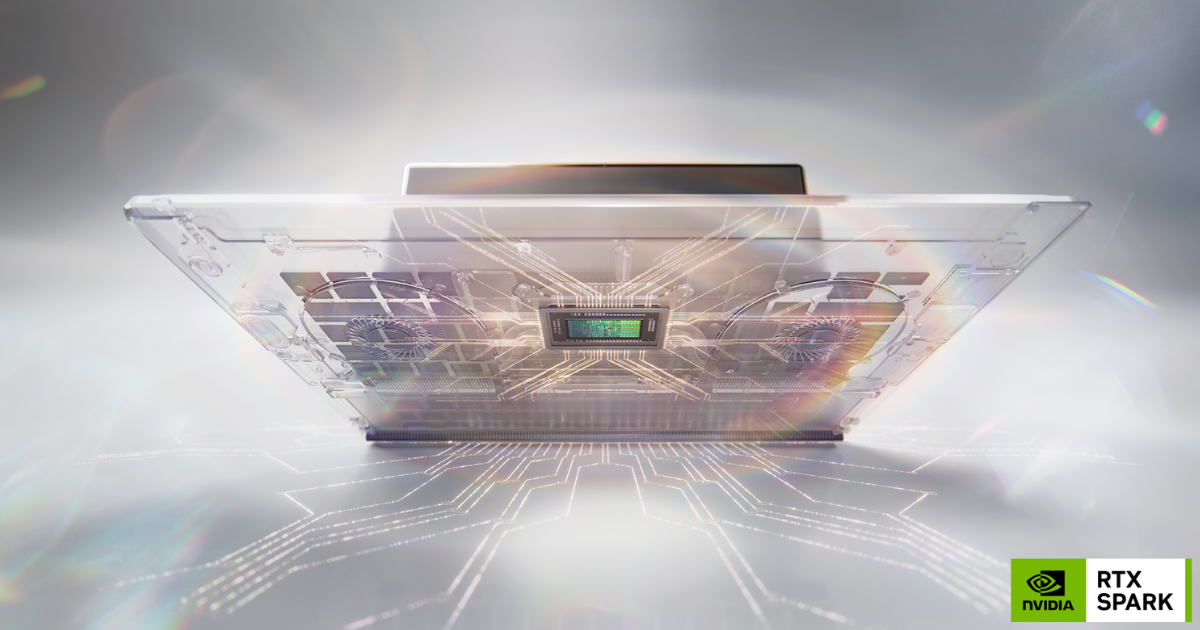
NVIDIA has just announced the all-new “RTX Spark”, a brand-new ARM-based superchip built specifically for AI-powered Windows PCs. This Chip was announced at GTC Taipei on May 31, 2026. The main aim of this superchip is to bring powerful on-device AI to slim Windows laptops and compact desktops, without depending on the cloud for the heavy processing. So yeah, this article will discuss everything you need to know about the NVIDIA RTX Spark, including its specs, features, and more!
Key Highlights
- Up to 1 PFLOP AI performance with 128GB unified memory
- Run 120B-parameter AI models and personal AI agents locally
- Native Windows AI agent support with Microsoft + NVIDIA OpenShell security
- AAA gaming at 1440p and 100+ FPS
- Adobe Photoshop & Premiere optimized for up to 2× faster AI and graphics performance
- RTX Spark-powered laptops and desktops arriving from major PC brands this fall.
NVIDIA RTX Spark Overview
Design and Architecture
The RTX Spark superchip features a 20-core NVIDIA Grace CPU (10 Cortex-X925 + 10 Cortex-A725) and an NVIDIA Blackwell RTX GPU (same as the NVIDIA RTX 5070 Desktop version) with 6,144 CUDA cores and fifth-generation Tensor Cores, all on a single piece of silicon.
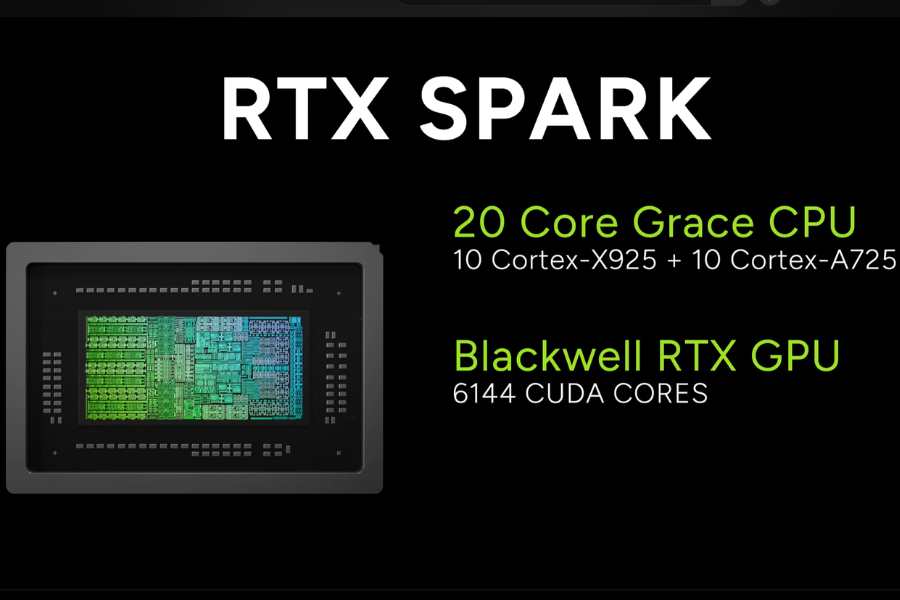
These two chips are connected via NVIDIA's NVLink chip-to-chip interconnect. Here, MediaTek also collaborated on the custom CPU design, contributing to its power efficiency and connectivity. As a result, the chip can deliver up to 1 petaflop of AI compute performance with up to 128GB of unified memory, which is enough to run 120-billion-parameter AI models entirely on your device.
AI Agents and Privacy
The headline feature of “RTX Spark” is its ability to run personal AI agents locally on your computer.
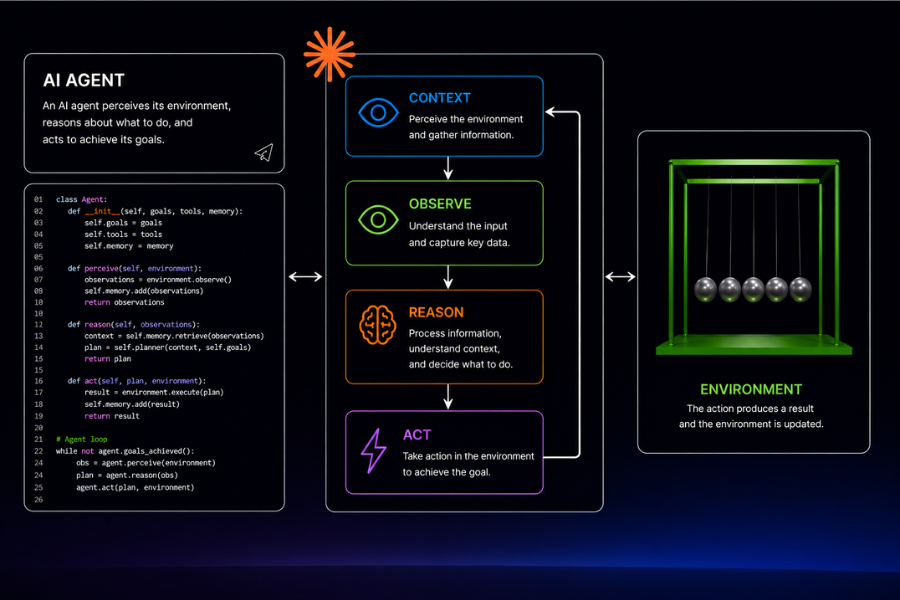
What is an AI Agent?
An AI agent is a smart software program that can understand your goal, make decisions, and take action on its own to complete a task.
Okay, let’s take an example:
Imagine you ask an AI agent, "Book me the cheapest flight from Kathmandu to Taiwan next weekend."
The AI agent can: Search for available flights, compare prices, choose the best option, fill in booking details, and complete the reservation. Instead of just giving information.
In simple terms: An AI chatbot answers questions, while an AI agent can do the work for you.
Currently, AI agents are becoming quite popular, with open-source projects like OpenClaw and Hermes Agent gaining significant attention from developers. These AI-powered tools can perform tasks autonomously, but their widespread adoption has been limited because running them securely and privately on personal computers still remains challenging.
To solve this, NVIDIA and Microsoft are working together to bring secure on-device AI agents to Windows PCs. NVIDIA is introducing OpenShell, a runtime layer that gives users control over what AI agents can access, routes requests to local AI models, and hides personal information before data reaches cloud services. At the same time, Microsoft is adding new security features to Windows to ensure AI agents operate safely and stay under the user's control.
Performance for Creators and Gamers
Talking about performance, the RTX Spark can render ultra-large 90GB 3D scenes with OptiX and DLSS, edit 12K 4:2:2 video with the NVIDIA Blackwell decoder, and run 120-billion-parameter large language models with 1-million-token context. Adobe is also rebuilding both Photoshop and Premiere from the ground up for RTX Spark, promising up to 2x faster AI and graphics performance across creative workflows. For gamers, NVIDIA is claiming 1440p at over 100 frames per second with ray tracing enabled.
Adding more, over 100 software providers and game developers, including Adobe, Blackmagic Design, ComfyUI, Xbox, NetEase, and Remedy Entertainment, are already on board with the platform.
You may also like:
- Nvidia Unveiled DLSS 5 at GTC 2026, and almost everyone has been calling it "AI Slop"
- Adobe and Nvidia unite together to transform the agentic future of Firefly
NVIDIA RTX Spark Availability
RTX Spark laptops and compact desktops will be available this fall from ASUS, Dell, HP, Lenovo, Microsoft Surface, and MSI.
- Meanwhile, check out our review of the Lenovo Legion 5 (2025)
Article Last updated: June 1, 2026