And just when you thought packing for a flight couldn't get more complicated, there's your power bank!
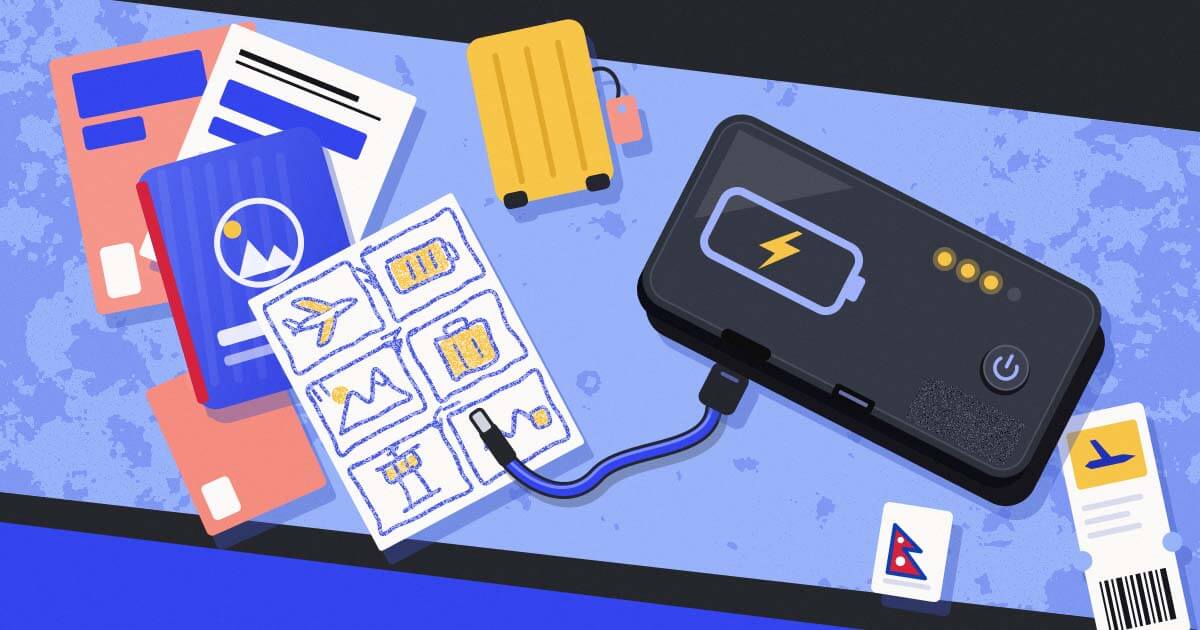
If you have travelling experience by plane, then you probably know the hassle that comes with carrying certain items. And power banks are one of them. Sure, they are essential when travelling long distances, as they keep our devices charged and let us stay connected. But as device batteries keep getting bigger, power bank capacities are also getting larger to keep up, raising safety concerns.
Key Highlights
- Power banks should be carried on cabin baggage only; forbidden in checked luggage.
- Allowed up to 100Wh (approx. 27,000mAh) without approval; 100–160Wh requires airline permission, and above 160Wh is banned.
- Limited to a maximum of two power banks per passenger (with carriers like Emirates/flydubai allowing only one).
- Recharging power banks in-flight is strictly banned by ICAO, and using them to charge devices is prohibited by most major airlines.
- Absolute ban on the MOBIKINS MK-PB-04 model on regional flights per India's DGCA and Nepal Airlines' guidelines.
So, can you fly with your power bank? Yes, you can, but there are certain restrictions you need to be aware of if you don't want it confiscated at airport security. Power banks must be carried in your hand luggage, their battery capacity must be within the permitted limit, and some airlines don't allow passengers to use them during flights.
These rules became stricter in 2026, following new restrictions introduced by the International Civil Aviation Organization (ICAO). Moreover, individual airlines can have different requirements, particularly regarding how many power banks you can carry and whether you can use them onboard. Whether you're flying within Nepal or travelling internationally, here's what you need to know before packing your power bank.
What Are the Rules for Carrying Power Banks on Flights?
When travelling with a power bank, the first thing to check is its battery capacity, which is usually measured in watt-hours (Wh). Most airlines allow power banks rated at up to 100Wh without prior approval, while larger ones may require permission or may not be accepted at all.

The International Civil Aviation Organization (ICAO) also introduced new restrictions effective March 27, 2026. Under these rules, each passenger can carry a maximum of two power banks on a flight, and recharging them during the flight is prohibited. However, individual airlines can impose stricter requirements, so the exact restrictions may vary depending on the airline you're travelling with. Here's how the different capacity limits work.
Power Banks Up to 100Wh
As mentioned, power banks rated at 100Wh or below are generally permitted in cabin baggage without prior airline approval. This includes most commonly available 10,000 mAh and 20,000 mAh power banks.
But remember, meeting the capacity requirement is only one part of the rules, as airlines may have their own restrictions on the number of power banks allowed, how they're stored, and whether passengers can use them onboard.
Power Banks Between 100Wh and 160Wh
For now, the rules for the larger power banks rated above 100Wh but within 160Wh are less consistent.
ICAO's updated technical instructions include a provision allowing batteries in this capacity range with airline approval. However, IATA's passenger guidance, updated on March 31, 2026, specifically lists power banks above 100Wh as forbidden.
Likewise, the individual airline policies also differ. Singapore Airlines and Malaysia Airlines, for example, publish conditions for accepting power banks between 100Wh and 160Wh with prior approval. Meanwhile, Emirates and Thai Airways have stricter limits and do not permit power banks exceeding 100Wh.
All in all, if your power bank exceeds 100Wh, you should not assume it will be accepted simply because it's below 160Wh. Check your airline's official policy and obtain confirmation before travelling. But again, getting airline approval doesn't necessarily guarantee that your power bank will be accepted at the airport.
Power Banks Above 160Wh
Now, power banks exceeding 160 Wh are not permitted as ordinary passenger baggage, whether in your carry-on or checked luggage. Such large batteries may need to be transported separately under dangerous-goods cargo requirements, rather than being carried by a passenger.
How Many Power Banks Can You Carry?
Under ICAO's updated rules, passengers can carry a maximum of two power banks per person. Previously, power banks were grouped with spare lithium batteries, which had different quantity limits. The 2026 changes introduced a separate restriction specifically for power banks.
Still, individual airlines can be stricter. For instance, Emirates and flydubai permit only one power bank per passenger, while Qatar Airways and Air India allow two.
Can You Put a Power Bank in Checked Baggage?
Now that you have an idea of which power banks are allowed on flights, you should also be careful about where you put them. Power banks are not allowed in checked baggage and must always be carried in cabin baggage.
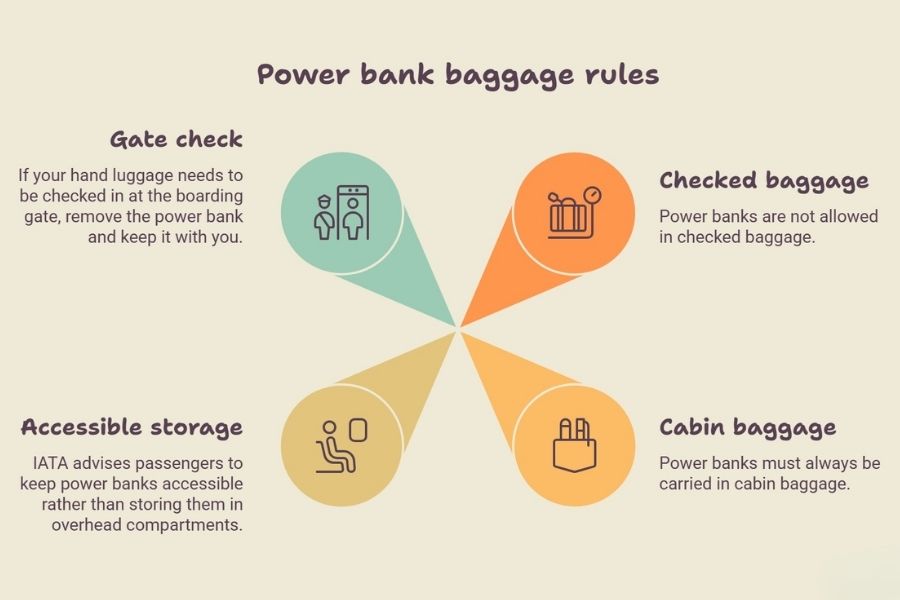
This is mainly for safety reasons. Because lithium batteries can overheat, smoke, or catch fire if they become damaged or develop a fault—keeping them in the cabin makes it easier for the crew to identify and respond to such incidents.
IATA also advises passengers to keep power banks accessible rather than storing them in overhead compartments. And if your hand luggage needs to be checked in at the boarding gate, make sure you remove the power bank and keep it with you.
Power bank capacity restrictions at a glance:
| Power bank capacity | Can you carry it? | Airline approval |
| Up to 100Wh | Generally allowed in cabin baggage | Usually not required |
| Above 100Wh to 160Wh | Depends on the airline and applicable requirements | Required where permitted |
| Above 160Wh | Not permitted as ordinary passenger baggage | Not applicable |
Note: ICAO and IATA guidance differ on the 100–160Wh category.
How to Check If Your Power Bank Is Allowed on a Flight
Most power banks have their battery capacity printed somewhere on the body, usually on the back or bottom, in milliampere-hours (mAh), watt-hours (Wh), or both.
It is important to note that while manufacturers typically advertise power banks using figures like 10,000mAh or 20,000mAh, airlines use watt-hours to determine how much energy a battery stores. So, if you don't know the Wh rating of your power bank, you can calculate it using this formula:
How to Calculate Watt-Hours (Wh) From mAh
Milliampere-hours (mAh) indicate a battery's charge capacity, while watt-hours (Wh) measure how much energy it stores. To convert mAh into Wh, you also need the battery's voltage, usually listed on the power bank's label as its nominal voltage.
The formula is:
Wh = (mAh × Battery Voltage) ÷ 1,000
For example, let's take a 20,000mAh power bank with a battery voltage of 3.7V.
Wh = (20,000 × 3.7) ÷ 1,000 = 74Wh
In case your power bank doesn't explicitly list the Wh rating on its body or in its specifications, you can use 3.7V as a reference, as this is the nominal voltage used by many power banks. However, check the manufacturer's specifications if a different voltage is listed.
| Power bank capacity | Approx. energy at 3.7V | Airline approval |
| 5,000mAh | 18.5Wh | Within the limit |
| 10,000mAh | 37Wh | |
| 20,000mAh | 74Wh | |
| 27,000mAh | 99.9Wh | |
| 30,000mAh | 111Wh | May depend on the airline |
What If the Capacity Marking Is Missing or Unreadable?
Another important thing to check before travelling is whether your power bank has a clearly visible capacity label. A missing or faded label can create problems at airport security, even if your power bank is relatively small.
According to IATA's guidance, lithium-ion batteries should have their watt-hour ratings marked on the casing. This allows airline and airport staff to identify the battery capacity and check whether it falls within the permitted limits.
If the label has worn off, you can check the manufacturer's website, product specifications, or user manual. You can also contact the manufacturer for documentation showing the battery capacity.
However, having this information separately may not be enough if the original marking is unreadable. So, it's best to carry a power bank with a clearly readable capacity label to avoid any unnecessary hassle at the airport.
What About Using a Power Bank During a Flight?
Alright, now that we are clear about what you can and cannot carry, you might think that's all there is to it. But that's not the case. Even if your power bank meets the capacity requirements, that doesn't necessarily mean you're allowed to use it onboard. There is also a separate restriction on recharging the power bank itself.
Can You Use a Power Bank to Charge Your Phone?
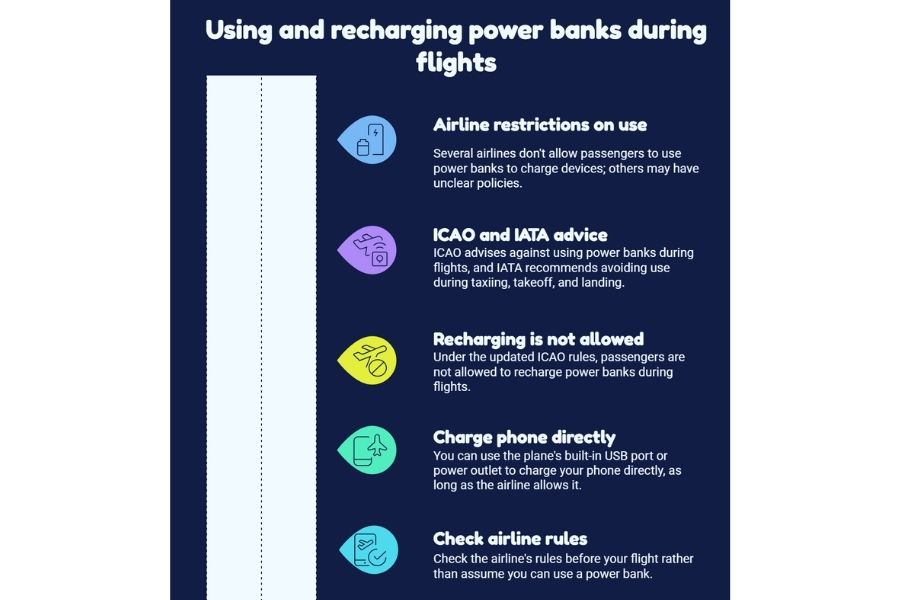
The simple answer is that it depends on the airline you are travelling with. Several airlines, including Emirates, flydubai, Air India, Singapore Airlines, Malaysia Airlines and Turkish Airlines, don't allow passengers to use power banks for this purpose. Nepal Airlines and Himalaya Airlines have similar restrictions.
ICAO also advises against using power banks to charge other electronic devices during flights, although individual airlines can go a step further and prohibit it altogether. Similarly, IATA recommends avoiding power bank use during taxiing, takeoff, and landing.
However, not every airline has the same policy. Some don't clearly mention whether passengers can use power banks to charge their devices onboard. So, it's best to check the airline's rules before your flight rather than assume you can use one.
Can You Recharge a Power Bank During a Flight?
No. Under the updated ICAO rules, passengers are not allowed to recharge power banks during flights. So, you cannot simply plug your power bank into the aircraft's USB port or power outlet to top up its battery.
But that doesn't mean you cannot charge your phone onboard. You can still use the plane's built-in USB port or power outlet to charge your phone directly, as long as the airline allows it. Just remember that some airlines may have their own restrictions on this too.
Why Are Airlines Restricting Power Bank Use?
With the long list of do's and don'ts, you might be thinking, why so many rules in the first place? Well—the main concern is the potential fire risk associated with lithium-ion batteries.
Although these batteries are generally safe when manufactured and used properly, defects, physical damage, overheating, or internal short circuits can sometimes cause them to fail.
In serious cases, a battery can enter a condition called thermal runaway, where it rapidly heats up and may release smoke, flames, or hot gases.
Such incidents are particularly concerning inside an aircraft, which is why airlines have become more cautious about passengers using and storing power banks during flights.
Keeping power banks accessible also allows passengers and crew to notice potential problems earlier.
Note: If your power bank becomes unusually hot, starts swelling, produces smoke, or shows signs of damage during a flight, inform the cabin crew immediately. Don't attempt to open, repair, or handle a smoking or burning battery yourself.
Power Bank Rules in Nepal: What Travellers Should Know
When flying from Nepal, the aviation safety requirements and airline policies are not always the same. While international aviation standards provide the general framework, individual airlines may have additional restrictions that you need to be aware of.
Nepal's Restrictions on the Power Bank
Till now, there hasn't been a separate passenger-specific power bank regulation in Nepal; however, there is one recent restriction worth noting, especially if you're travelling between Nepal and India.
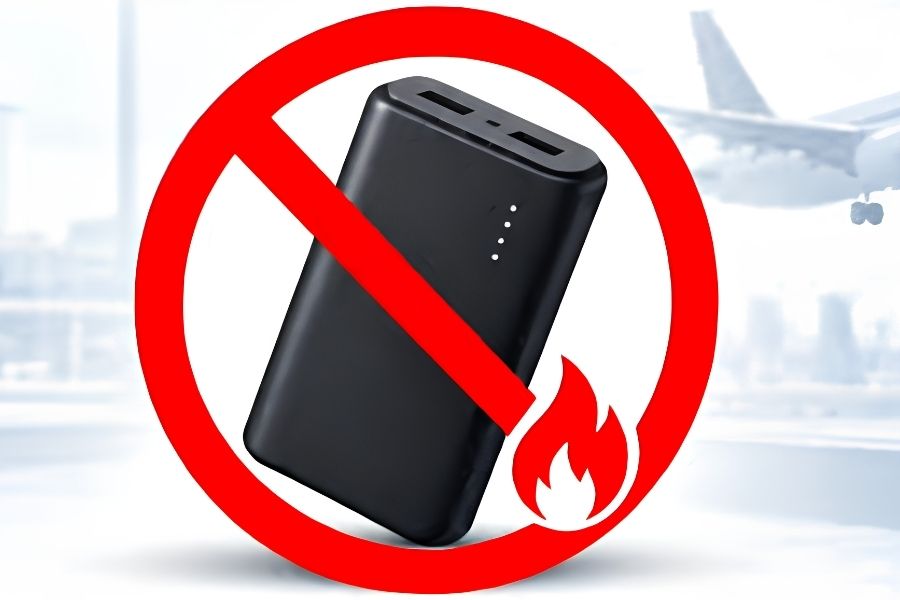
The restriction is related to the MOBIKINS MK-PB-04 power bank, which is prohibited on flights to, from, and within India under India's DGCA Aeronautical Information Circular 14/2026. Nepal Airlines also issued a notice about this restriction on October 13, 2026.
The ban covers all forms of baggage, so you cannot carry this particular model in either your hand luggage or checked baggage. Buddha Air also lists it among its prohibited items.
Keep in mind that this is not a general ban on power banks. It applies specifically to the MOBIKINS MK-PB-04, while other models remain subject to the usual capacity limits and airline policies.
Power Bank Policies of Airlines Flying to and From Nepal
As I have said continuously, the rules can vary quite a bit from one airline to another. So, here's what some of the major airlines flying to and from Nepal currently allow.
| Airlines | Capacity allowance | Onboard use |
| Nepal Airlines | Up to 100 Wh; 100- 160 Wh with approval on certain airlines | Using and recharging power banks prohibited |
| Himalaya Airlines | ||
| Buddha Air | Not specified | |
| Yeti Airlines | Not specified | — |
| Shree Airlines | Not specified | — |
| Sita Air | Not specified | — |
| Summit Air | Not specified | — |
| Tara Air | Not specified | — |
Note: While we couldn't find specific power bank capacity limits clearly published by individual Nepali airlines, they are all expected to follow the international aviation safety guidelines established by ICAO and IATA.
International Airlines
Since many Nepalis fly abroad, whether for work, studies, or other reasons, it's worth knowing the power bank rules of the international airlines commonly used for these journeys. Here are some of the major airlines you might fly with and what you need to know about their power bank policies.
| Airline | Capacity Limit | Maximum Number | Approval Requirements | Onboard Use and Recharging |
|---|---|---|---|---|
| Qatar Airways | Up to 100Wh | 2 | No allowance above 100Wh | Recharging prohibited; device charging not explicitly clarified |
| Emirates | 1 | Both prohibited | ||
| flydubai | 1 | |||
| Air India | 2 | |||
| IndiGo | Up to 100Wh; 100–160Wh conditionally | 2 | Approval and security clearance for 100–160Wh | |
| Thai Airways | Up to 100Wh | 2 | No allowance above 100Wh | Not specified in available policy |
| AirAsia | 2 | Both prohibited | ||
| Malaysia Airlines | Up to 100Wh; 100–160Wh conditionally | 2 | Airline approval for 100–160Wh | |
| Singapore Airlines | 2 | Prior approval for 100–160Wh | ||
| Turkish Airlines | Up to 100Wh | 2 | No allowance above 100Wh |
Note: These policies reflect the available official information as of November 2026. Airline restrictions may change, so always confirm the latest requirements before travelling.
As you can see, not every airline follows the same limits. For instance, if you're flying to Dubai with Emirates or flydubai, you can carry only one power bank, even though the general ICAO limit is two. Similarly, some airlines may accept power banks above 100Wh with prior approval, while others don't allow them at all.
And if you're taking a connecting flight with different airlines, don't forget to check the rules of each one. Just because your power bank is accepted by one airline doesn't necessarily mean the next one will allow it too.
Are Magnetic or Wireless Power Banks Allowed on Flights?
Yes, magnetic and wireless power banks are generally subject to the same battery capacity, quantity, and baggage restrictions as regular power banks.
However, they should be protected against accidental activation. For example, a magnetic power bank should not accidentally begin charging your phone while stored in your bag or pocket.
If your airline prohibits using power banks onboard, that restriction also applies to wireless charging.
Things to Remember Before Flying With a Power Bank
So, before heading to the airport, here are a few things worth checking to avoid problems during security checks or boarding.
- Check the Wh rating: Make sure your power bank is within the permitted capacity. Models at or below 100Wh are generally the easiest to travel with.
- Confirm your airline's quantity limit: ICAO's general maximum is two, but some airlines, including Emirates and flydubai, allow only one.
- Keep it in cabin baggage: Never pack a power bank in checked luggage. Remove it if your hand luggage needs to be checked in at the boarding gate.
- Protect it properly: Use a suitable pouch or protective packaging to prevent short circuits and accidental activation.
- Keep it accessible: Follow your airline's storage instructions, particularly restrictions on overhead compartments.
- Check its condition: Avoid carrying damaged, swollen, overheating, or recalled power banks.
- Follow onboard restrictions: Don't use or recharge your power bank unless the airline explicitly permits the activity.
- Check connecting flights: If you're travelling with multiple airlines, make sure your power bank meets the requirements of every carrier.
Conclusion
Overall, power banks are still allowed on most flights, but the restrictions are stricter than before. For most passengers, a clearly labelled power bank rated at or below 100Wh is generally the easiest option to travel with.
If you're carrying a larger model, make sure its capacity is clearly marked and confirm its acceptance with your airline before heading to the airport.
Article Last updated: November 5, 2026