Leaks show that the upcoming Snapdragon 8 Elite Gen 6 might use both TSMC and Samsung foundries
By
Published 4 days ago
No headings found
Qualcomm isn't close to announcing its next flagship mobile chipset yet, but it appears that they will use both TSMC and Samsung foundries for the upcoming generation. Digital Chat Station has provided some early information on two chipsets codenamed SM8950 and SM8975, which are expected to be the Snapdragon 8 Elite Gen 6 and Snapdragon 8 Elite Gen 6 Pro. This article will discuss what we know about Qualcomm's next flagship chips and the rumored dual-foundry strategy.

Qualcomm Snapdragon 8 Elite Gen 6 Rumors
TSMC N2P as the Expected Node
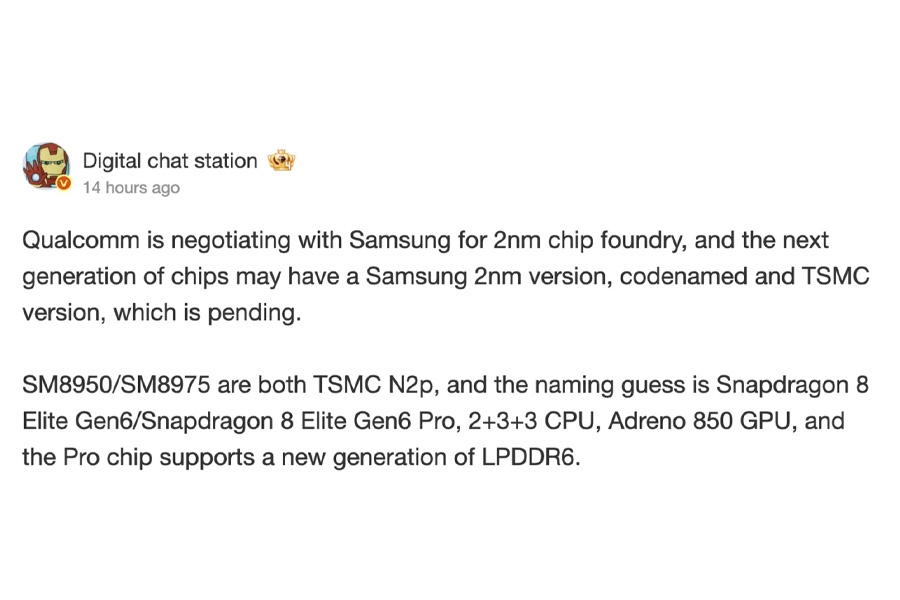
So the earlier expectations pointed to Qualcomm using TSMC's N2P fabrication node for these chips. According to internal analysis, TSMC N2P offers around 18% performance improvement over TSMC N3E and over 33% reduction in power consumption. TSMC N3E currently underpins chips like the Snapdragon 8 Elite for Galaxy, which is used in the Galaxy S25 Ultra. The current expected lineup is SM8950 for the Snapdragon 8 Elite Gen 6 (TSMC N2P) and SM8975 for the Snapdragon 8 Elite Gen 6 Pro (TSMC N2P).
Samsung Foundry Variant on the Table
But Digital Chat Station now claims Qualcomm may also use Samsung Foundry's 2nm process for this generation. It's quite known that, Qualcomm has relied heavily on TSMC for its flagship chips in recent years, and Samsung Foundry's track record with advanced nodes has been quite poor, to be frank. The Samsung Foundry-based variant will likely appear later and use a different codename.
Another speculation is already surfacing, namely that the Qualcomm-Samsung Foundry collaboration could already appear this generation, possibly as a new Snapdragon 8 Elite Gen 5 variant expected for Samsung's upcoming foldable devices.
- Also, read
Why Use Two Foundries?
Although we aren't entirely sure about this scheme. But a possible reasoning could be that TSMC and Samsung Foundry give Qualcomm supply chain flexibility. But there is also a downside for Qualcomm. It's mainly a potential performance inconsistency between variants. TSMC and Samsung's 2nm nodes are likely to deliver different performance and power efficiency, which means devices using different variants could have measurable differences in performance or efficiency.
Qualcomm Snapdragon 8 Elite Gen 6 Conclusion
If Qualcomm does use both TSMC and Samsung foundries, it wouldn't be unprecedented. AMD uses both TSMC and Samsung for some of its chips, and Apple has used multiple foundries in the past as well. Let's see how it will turn out for Qualcomm.
- Meanwhile, check out our review of the OnePlus 15
Article Last updated: January 11, 2026