Nepal has opened the door to international payment gateways—but how difficult will the journey be?
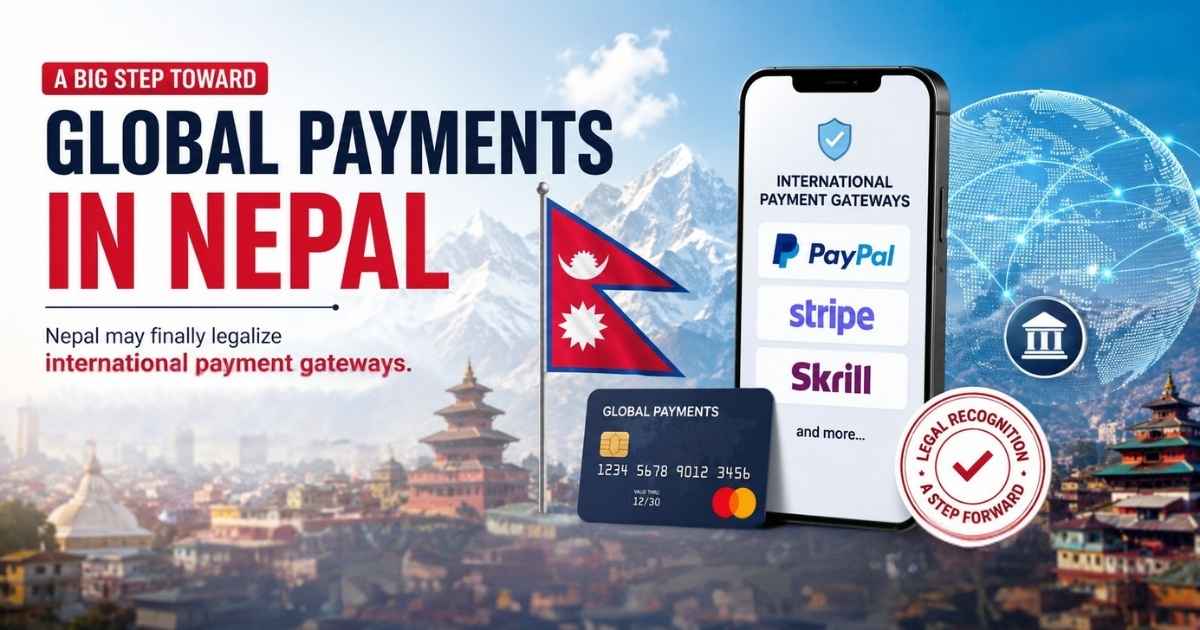
Though the growing trend of remote work has created opportunities for many Nepali users. Also, the growing social creator market has created opportunities for creators, startups, and online businesses in international markets. But the concern for those industries is getting paid from abroad easily. Whether you are freelancing for a foreign client, selling software, or running a SaaS product, Nepal's payment system for international payments always feels a generation behind the global digital economy. After a long time, we are seeing a path to change this situation. In this article, I will discuss everything about this issue, along with the government's latest announcement to resolve it.
Payment Gateway Legalization Overview
Government announcement
Nepal's government is introducing numerous new policies for FY 2083/2084 in the IT sector. Under this policy, President Ram Chandra Poudel announced that Nepal is planning to provide legal recognition to international payment gateways. With this step, the government aims to improve foreign currency earnings and tax management in a simple, easy way. With this policy, we might see payments for digital trade, remote work, and knowledge-based services become easier.

I just want to temper your excitement about “PayPal” entering Nepal, as this announcement is, for now, only at the policy level. and the official announcement from the international payment gateway, like PayPal, Stripe, Skrill, or any other global platform, has not yet been made. So, we need to wait longer until all these platforms officially announce their launches in Nepal.
The good part of this announcement is that, if this policy is implemented properly, it could help Nepal take a step toward establishing a foothold in the digital economy. The government also said that, with this policy, they plan to expand the double taxation avoidance agreement with several countries and reduce the burden on middle-class households.
What exactly did Nepal's government announce?
As I mentioned earlier, our president has announced plans to legalize international payment gateways in Nepal. The government is taking this move so that Nepalese people can receive foreign payments more easily, and this not only makes receiving foreign currency easier but also allows the government to manage its taxation more efficiently.
This policy will further push Nepal towards establishing a strong digital economy. Alongside payment, the government is also planning to promote IT as a strategic sector to encourage digital trade, remote work, software exports, cloud services, cybersecurity, AI-related services, and other knowledge-based industries. So, this is not only about PayPal but also about establishing the digital economy held in the global market.
At this point, we can see multiple local digital payment platforms like eSewa, Khalti, IME Pay, Fonepay, and ConnectIPS. These platforms are useful for payment within Nepal only. When it comes to receiving international payments from foreign clients or accepting card payments from global customers, we encounter major complications. This is the exact area where these international payment gateways come in use.
Are PayPal and Stripe really coming to Nepal?
I feel that gateways like PayPal and Stripe will not enter Nepal immediately. since the government's announcement is just an initial step toward creating the legal and regulatory framework for those platforms. For the proper operation of those platforms, the government needs to work effectively on other regulatory factors, such as banking integration, compliance structures, and local resource partnerships.
At the moment, Nepal is moving closer to legally recognizing international payment gateways, but the official launch of PayPal and Stripe has not yet been confirmed. We need to understand this because many social media posts are causing a stir among the Nepali community by claiming that PayPal is coming to Nepal by next week, which is just a rumor.
Although we can see Nepal listed on PayPal's official global countries page, this does not mean Nepali users receive full merchant payments, have business account support, or have a bank withdrawal feature, unlike users in fully supported markets.
Meanwhile, Stripe is already available in Nepal through a collaboration with Khalti by IME. But it does not mean you get full access to the Stripe wallet, as Nepal is not listed among the supported countries for standard payment acceptance on Stripe's official availability page. While Stripe has said that businesses can register their interest, some of you can also use Stripe Atlas, depending on your company structure. Here, you can only generate a payment link in the Khalti app.
How does it affect the freelancers?
This might be the question you had when you first learned of this announcement. Let me explain to you in detail.
We have seen that in recent years, recognition of Nepali freelancers in software development, design, video editing, content writing, digital marketing, consulting, animation, UI/UX, and many other online services is growing day by day. And receiving payment for their hard work has not been that easy for them.
Some freelancers use Payoneer, while others rely on SWIFT bank transfers. While some even ask clients to send money through a platform supported by freelance marketplaces. We have seen some of them even ask friends or relatives working abroad for help. Here, in response to this market gap, some of them have set up companies outside Nepal just to access proper payment gateways. With this complicated payment frame, we can see the friction in the market. And for a country like Nepal, which is trying to establish its foothold in IT exports, this complication is a major issue that needs to be solved in time.
If international payment gateways are legalized and properly integrated into Nepal's banking ecosystem, Nepali freelancers will not have to struggle much with payments. They can have their hard-earned money at their fingertips with more transparency. With this, not only freelancers but also the Nepalese government can operate transparently for digital taxation.
- Also Read:
- SEE Result 2082/83: How to Check SEE Result with Marksheet Online
- Nepal Replaces Chip-Based Smart License With I-QR System
- Sajha Yatayat’s AI Control Room to track buses, passengers, and safety in real time
Does this policy apply only to freelancers or also to SaaS businesses and Startups?
Well, for startups, international payments are a bigger problem. To understand this, let's take an example of a Nepali user who has a SaaS product ready and is willing to sell it to clients around the world. This product might be the need of the moment and has a website ready too. After pitching to multiple businesses, let's say they also get the client. But the main issue the owner will face is getting payment through the international card in Nepal, as the process is not that easy.
This is the gap that forces the Nepali startup to register its company abroad or to seek a complicated workaround to receive payment. This is the gap that Nepal needs to address very soon through strong policy implementation, not just announcements, to become a global player for software exports to international markets. So, with this legal recognition, we can see a bright future for the SaaS industry in the coming days.
What about Creators and Online business?
Creators, newsletter writers, digital product sellers, online educators, and small e-commerce businesses are other areas where we can see the positive impact of this policy.
We all know that if someone from Nepal looks to sell their digital course, template, app, plugin, e-book, design pack, or subscription service to an international audience, the only issue they face is collecting payment. So, after the implementation of this policy, those people can
- Accept international cards
- Sell digital products globally
- Receive subscription payments
- Get paid by foreign clients more conveniently
- Bring foreign currency into Nepal through the legal channel
- Maintain better tax and income records
For a country like Nepal, where many young people have opted for working online, this legal recognition makes great sense for digital reform.
But just legal recognition is enough…
Well, the answer is actually no. Here, implementing this policy properly plays a vital role. By simply announcing legal recognition through policy, PayPal and Stripe will not immediately begin operating in Nepal. The government needs to assess the policy's depth alongside major regulatory updates to the Nepal Rastra Bank's foreign exchange, payments, settlements, merchant accounts, and anti-money laundering compliance, KYC, and other policies.
Moreover, existing banks and payment companies need to build infrastructure to assess Nepal's commercial and legal viability in the global market. So that the company, like PayPal, can make investment decisions here. There also needs to be a local partnership, as some fintech companies in Nepal are already exploring Stripe-powered international payment services. In this context, we also shared that Khalti by IME is partnering with Stripe to help Nepali freelancers and digital entrepreneurs get international payments.
This announcement shows that the government is prioritizing the development of Nepal's digital economy, but it needs to address many other sectors before implementing this policy.
Is this the right time?
Honestly, I feel Nepal is way behind the rest of the world in terms of digitization. This step could be the catalyst for development. while it also gives other, bigger picture, aiming for sustainable economic growth.
We know that Nepal was, and remains, heavily dependent on remittances and labor migration. But with time, the way of earning income is also shifting. A person living in Kathmandu does not need to migrate to the USA to work as a software developer at a US company. A designer from Pokhara can sell templates globally. while a creator in Nepal earns income from YouTube, affiliate programs, or digital products by staying at home.
Though we have plenty of these opportunities, earning the hard-earned payment is not easy. It's like fighting a war to get what you deserve. So most of them use an informal workaround, which is not only complicated for users but also makes it difficult to file proper taxes. Which means that when international payments come through the legal channel, both the user and the governments will be in win win stituation. Here, the user will have a simple payment method, while the government can also increase its foreign currency inflows.
What might go wrong?
As we all know, in terms of infrastructure and technology, Nepal does not have a secure hold or reputation in the international market. There will be plenty of risks this policy might bring. I have listed the risk below:
- To begin, implementation of this policy may be slow, as it is still in its initial phase. And we have also seen in the past that Nepal has announced many good digital policies, but at the time of execution, they get delayed by years.
- Secondly, the rules might appear restrictive, bringing complications to the payment process. As a result, most freelancers and small businesses might avoid using the formal channels.
- The other risk is that the international payment gateway might not enter Nepal, even after Nepal announces its new digital payment policy. Companies like PayPal and Stripe analyzed market size, regulations, risk, banking partners, fraud management, and business demand before expanding their operations.
- Furthermore, the government needs to establish clear taxation rules that can be implemented in practice. If the system becomes confusing or punitive, people may continue using the unofficial method. So, it is necessary to have simple and business-friendly rules.
What's next?
Firstly, Nepal needs to develop a clear roadmap for implementing this policy after completing the in-depth analysis. Here, Nepal Rastriya Bank plays the main role. Here are a few steps for the successful implementation of the policy.
- NRB should clarify how international payment gateways will be licensed to operate in Nepal.
- The government also needs to explain the taxation policy and framework to freelancers, creators, IT companies, and more.
- The bank should be ready for foreign currency settlement.
- Payment companies should be encouraged to integrate with global networks.
- And most importantly, the policy should adhere to the simple and practical rule that every individual can understand and follow.
In short, I feel Nepal does not require an advanced policy framework tailored to large companies. The system should be designed so that a 22-year-old freelancer, a small SaaS founder, a YouTuber, or a digital agency can understand it without brainstroming.
Payment Gateway Legalization: Conclusion
It's good to see that Nepal is finally recognizing the need to integrate international payment gateways into the national infrastructure. This could be the turning point for digitally reforming the country's economy. Here, the government needs to focus on creating practical rules that could be implemented easily. We need to understand that gateways like PayPal and Stripe will not be fully available in Nepal that easily by simply announcing a policy reform.
At this moment, the government has only now acknowledged the problem that freelancers, startups, creators, and online businesses have been facing for years. And if this is implemented properly, Nepal could finally take steps toward creating a skilled digital workforce that can not only earn for themselves but also contribute to the country's economic growth. With this, Nepal might finally convince the youth to stay in the country while also helping establish a digital workforce that could compete in the global market.
This is not the ending, but it is a golden beginning from the Government of Nepal to help young people across the country flourish in their future.
- Meanwhile, you may like our review of Honor Midrange phones in 2026.
Article Last updated: May 13, 2026



.png)