Why Trust Gadgetbyte?
At Gadgetbyte, we invest substantial hours into rigorously testing each product or service we review, guaranteeing that you make informed purchases. Learn more about our testing process.
Review Overview
4.6
Design & Build
10/10
Display
10/10
Performance
9/10
Back Camera
9/10
Front Camera
8.5/10
Software & UI
9.5/10
Battery
9/10
Value for money
8.5/10
Samsung Galaxy S20 and S20+ are some of the best Android phones you can buy right now. It features a sleek design, an exceptional 120Hz AMOLED panel, and a whole new camera system with features like 8K recording and 30X Space Zoom. For the first time, we've such a radical upgrade between any two consecutive iterations of a Samsung flagship phone. Having said that, there are some things the company should work on like the camera software to further enhance the phone's possibilities.
Samsung Galaxy S20, S20+ Specifications:
| Specifications | Samsung Galaxy S20 | Samsung Galaxy S20+ |
| Body | 5.97 x 2.72 x 0.31 inches; 163 gm; IP68 certification | 6.37 x 2.90 x 0.31 inches; 186 gm; IP68 certification |
| Display | 6.2-inches “Infinity-O” Dynamic AMOLED 2X panel; 120Hz refresh rate; HDR10+; 563 PPI; 89.5% screen-to-body ratio; Gorilla Glass 6 protection | 6.7-inches “Infinity-O” Dynamic AMOLED 2X panel; 120Hz refresh rate; HDR10+; 525 PPI; 90.5% screen-to-body ratio; Gorilla Glass 6 protection |
| Rear Camera | Triple camera; – 12MP, f/1.8 primary shooter, OIS, DPAF – 12MP, f/2.2 ultra-wide sensor – 64MP, f/2.0 telephoto lens, PDAF, 3X hybrid optical zoom – LED flash | Quad-camera; – 12 MP, f/1.8 primary shooter, OIS, DPAF – 12MP, f/2.2 ultra-wide sensor – 64MP, f/2.0 telephoto lens, PDAF, 3X hybrid optical zoom – 0.3MP ToF 3D DepthVision sensor – LED flash |
| Battery | 4000 mAh; 25W fast charging; 15W Fast Wireless Charging 2.0; 9W reverse Wireless PowerShare | 4500 mAh; 25W fast charging; 15W Fast Wireless Charging 2.0; 9W reverse Wireless PowerShare |
| Colors | Cosmic Grey, Cloud Blue, Cloud Pink | Cosmic Grey, Cloud Blue, Cosmic Black |
| Price in Nepal | Rs. 1,07,499 (8/128GB) | Rs. 1,19,999 (8/128GB) |
| Resolution | QHD+ (3200 x 1440 pixels); 20:9 aspect ratio | |
| Chipset | Exynos 990; 7nm+ Mobile Platform | |
| CPU | Octa-core (2×2.73 GHz Mongoose M5 & 2×2.60 GHz Cortex-A76 & 4×2.0 GHz Cortex-A55) | |
| GPU | Mali-G77 MP11 | |
| RAM | 12GB LPDDR5 (5G) / 8GB LPDDR5 (LTE) | |
| Storage | 128GB UFS 3.0 (expandable up to 1TB via a microSD card) | |
| Software & UI | Android 10 with One UI 2.1 on top | |
| Front Camera | 10MP, f/2.2 aperture; Dual Pixel AF | |
| Camera features | Tracking AF, 8K video@24fps, 960fps slow-mo, Super Steady stabilization, etc. | |
| Security | Ultrasonic in-display fingerprint scanner, Face unlock | |
| Audio | Stereo speakers with Dolby Atmos, Dolby Digital/Plus | |
| Connectivity | Hybrid SIM (two Nano or one Nano-SIM + one MicroSD card), WiFi 802.11 a/b/g/n/ac/ax, Bluetooth 5.0, sub-6GHz 5G spectrum (also mmWave in S20+), GPS/AGPS/GLONASS/BDS, NFC, USB Type-C | |
Samsung Galaxy S20, S20+ Review!
Design
Starting with the design, the S20 and S20+ look identical, if not for the size. S20+ is the bigger of the two (as implied by the title), which means it also has a larger display & battery. And speaking strictly in terms of accessibility, I would lean a bit heavier on the S20 since I have fairly small hands. Anyways, throwing everything premium is the route Samsung takes with its flagship phones and this time’s no different either. Glass body, IP68 rating – you name it, the phone has it. But what is contrasting, is how the S20 & S20+ are such a hyperbolic successor to the S10 series. Now, Samsung has gone with a familiar color scheme on both phones which are classy in a subtle way like the ones they succeed, and therefore are not cartoonishly flamboyant. So many smartphones these days come with repulsively radical color schemes – yeah, you know who you are!
I'm against excessively curved displays & I'm not ashamed to admit it.
I’ve never been a fan of those excessively curved displays; not only because it’s less practical, but it also makes the device more vulnerable to damage in the process. Not saying the new screen is flat-out immune to accidental touches, but it is undoubtedly better than what we were used to seeing. It is just right for launching the edge-screen or using the new gesture system in Android 10. So, good job, Samsung. Buttons on the S20 & S20+ have gone through an overhaul too. They’re still made of metal but are placed far too ergonomically this time around, all on the right. A separate Bixby button’s gone and I’m in a quandary on what to feel about it; a separate remappable button is always a plus and now the option’s no more. That doesn’t mean Samsung’s digital assistant has kicked the bucket – the power button (or side key) also functions as Bixby trigger though you can reprogram that to launch the default power menu.Display
What Samsung has pioneered by this time is unquestionably the display. Every time the company launches a high-end smartphone, headlines fly around about how it’s got the best display in the market during the time. Well, they’ve outdone themselves with the S20 series. Featuring the signature QHD+ Dynamic AMOLED panel with HDR10+ support, the S20 with its 6.2-inches and the S20+ with its larger 6.7-inches screen also boasts a superior 120Hz refresh rate – a first for Samsung. It is smooth, oh-so-smooth, and snappy as well. So much so, that I can’t help but utter the cliché-d mantra –“you can’t tell the difference until you see it for yourself.”Now, I’ve been using a phone with the standard 60Hz display and couldn’t tell it apart from OnePlus 7T’s 90Hz panel. But boy did these phones sweep me off my feet! The 120Hz panel on the S20 & S20+ just… wooshes past the 90 and 60Hz panels. Who’d have thought that we would be dissing the 90Hz this early on!
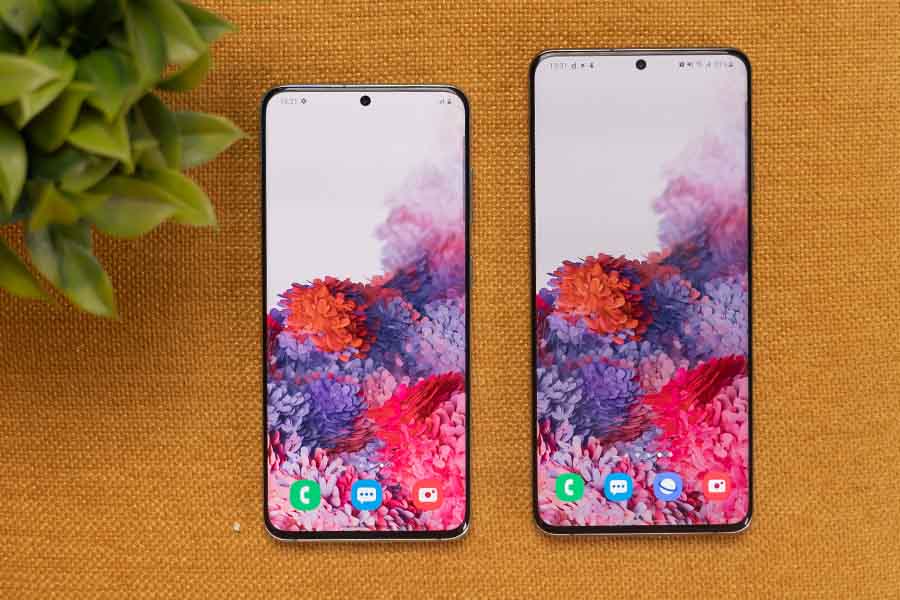
Although the display is a QHD+ panel, 120Hz is only supported in FHD+ resolution.
Looking at it through Samsung’s perspective, I can see why the company would want to make that confinement – to save battery, of course. But from a buyer’s point of view, it feels like a silly restriction. It most certainly is not a chipset limitation, as the new OPPO Find X2 Pro powered by the same Snapdragon 865 supports 120Hz @ QHD+ out-of-the-box. Here again, I had to really look for the difference between setting the phone to FHD+ & QHD+. And most of the time, I simply couldn’t tell. Add that to the battery-saving prospect by toning down the resolution, I personally don’t mind what Samsung has done. However, for the price-tag the phones come with, I feel like the company should’ve at least included the option. Let’s hope it does with a software update in the coming days. Other than that, the display on the S20 and S20+ deserve all the praise. They’re bright (even for sunny outdoors), have excellent colors & contrast ratio. The minimal bezels paired with a curved display absolutely takes the viewing experience to new heights. Furthermore, there’s also a dedicated “Video enhancer” feature that elevates the video quality in terms of colors & brightness in select applications like YouTube and Netflix. That reminds me, the S20 series recently received Netflix’s HDR playback support as well.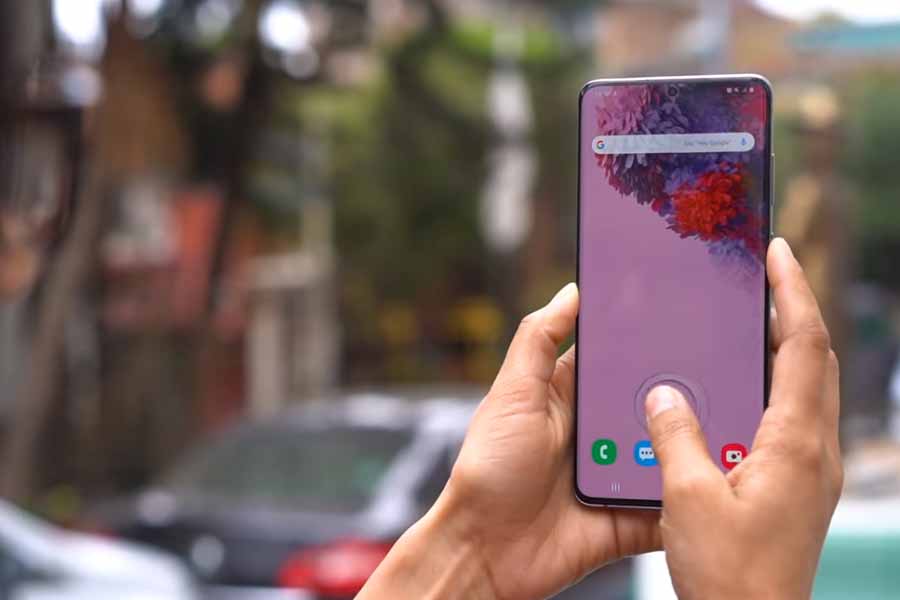
Performance
Getting to the performance, Samsung has also been marketing the S20 series as inherently 5G-capable phones, though that depends on the region you’re from. Seeing how most countries at this point don’t have a proper 5G infrastructure at this point, there’s also an LTE variant of the devices. And that’s what we have here in Nepal. Also, even if your area does get a 5G model, it’s important to note that the standard S20 only supports the sub-6GHz, while the S20+ & S20 Ultra also supports the faster mmWave spectrum of 5G. Couple this with the fact that mmWave 5G isn’t as widely available as sub-6GHz, you get a bucketload of reasons to not buy the new Galaxy S20 series just for their 5G capability. So much for “future-proofing”, I guess! Additionally, there’s one other difference between the 5G & LTE config of the phones – RAM capacity. In the case of S20 5G & S20+ 5G, you get 12GB of LPDDR5 RAM, whereas 8GB LPDDR5 is what you’ll be getting in their LTE variants.It's almost unfair that we don't get the Snapdragon-powered S20 devices.
Now, it’s the tale as old as times that Samsung’s Exynos always lag behind Qualcomm’s Snapdragon lineup of chipsets, especially in terms of graphics performance and battery endurance. And never has the difference between them been more pronounced than in the latest Exynos 990 & Snapdragon 865. Despite being fabricated using the same Samsung 7nm EUV process, the Snapdragon 865 wins out against the Exynos 990 in almost every facet, be it by a hair or a bigger margin.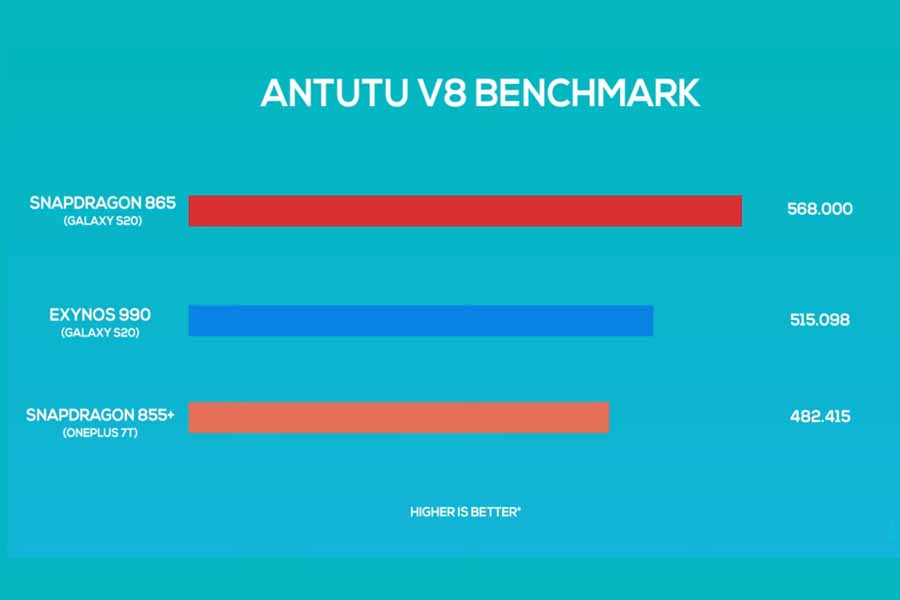
But that doesn't mean the Exynos 990 is downright terrible!
Having said that, everything runs like a breeze on the S20 & S20+. The One UI 2.1 is phenomenal & easy to use, multitasking is great and you can now have an app keep running in the background, even when you clear the memory. I said “an app” – singular, because it turns out that’s the limitation of the 8GB RAM on the phones. That number bumps up to 2 or 3, depending upon the available RAM.
Cameras
Time to talk about the cameras. Both S20 & S20+ come with a 12MP wide-angle lens, a 12MP ultra-wide lens, a 64MP telephoto lens with 3x optical zoom, while the S20+ also has an additional ToF DepthVision camera. Notice something different about how they’re arranged? Yeah, the camera sensors alongside the LED flash and the microphone are now placed inside a rectangular module.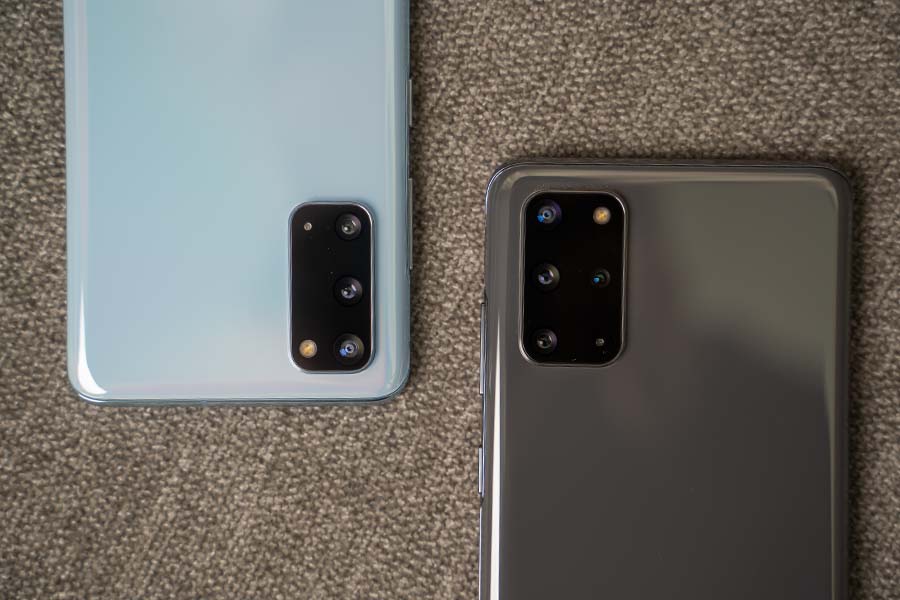
Normal Images
When it comes to normal images, the ones from iPhone 11 Pro offer a little smoothened shots with better dynamic range, and even better sharpness at times. On the contrary, images from the S20+ are a little saturated, but in a way that’s pleasing to the eyes.Wide-angle Images
Now, moving to the wide-angle images, the iPhone 11 Pro offers better brightness and color tone, though they’re visibly glared, thus giving off a bluish tint. Contrarily, wide-angle images from S20+ are very sharp & detailed.Selfies & Portrait selfies
Coming to the selfies, though it is color accurate, the subject is smoothened a bit on the S20+ while they are a little softened in a likable fashion in the iPhone 11 Pro. The portrait selfies, on the other hand, have the roles reversed. Here, images from the 11 Pro are hazy, smoothened, and susceptible to glare while S20+ has better edge detection.Portrait Images
The regular bokeh shots on the iPhone 11 Pro produce way too orangish images while subjects are highly smoothened on the S20+.Low-light Images
Samsung’s trademark sharpness & punchy colors get to shine on the night-time images as well, whereas low-light images on the iPhone 11 Pro are a bit color accurate with better details as well.Do we really need such a compromised 8K recording on a phone right now?
8K is another buzzword Samsung’s been throwing with the S20 series. Once again, that feels like a marketing gimmick at this point. Not only is it limited to mere 24fps, but it also:- lacks any sort of stabilization
- takes up a big chunk of storage (about 10 megabytes for each second of recording)
- and you lose a lot of the subject on the frame too.

Battery
Moving on, I was not expecting such great battery life on the Galaxy S20 & S20+ during my review, to be honest. Sure, there are a lot of variables to play around with like: brightness, resolution, and refresh rate, but I tweaked the settings according to the type of content I’d indulge in, and still got an exceptional endurance. By default, I kept the phones at about 50% brightness in FHD+ resolution and 60Hz refresh rate. And when I wanted to binge YouTube videos, I’d crank up the resolution to QHD+ or boost the refresh rate to 120Hz when I was in the mood for gaming. With this, the 4000mAh battery on the regular S20 gave me about 5 - 6 hours of screen-on time, with some juice to spare. Similarly, the S20+ yielded an even better endurance, thanks to its bigger 4500mAh cell. Thus, it easily makes both Galaxy S20 & S20+ “all-day battery” phones.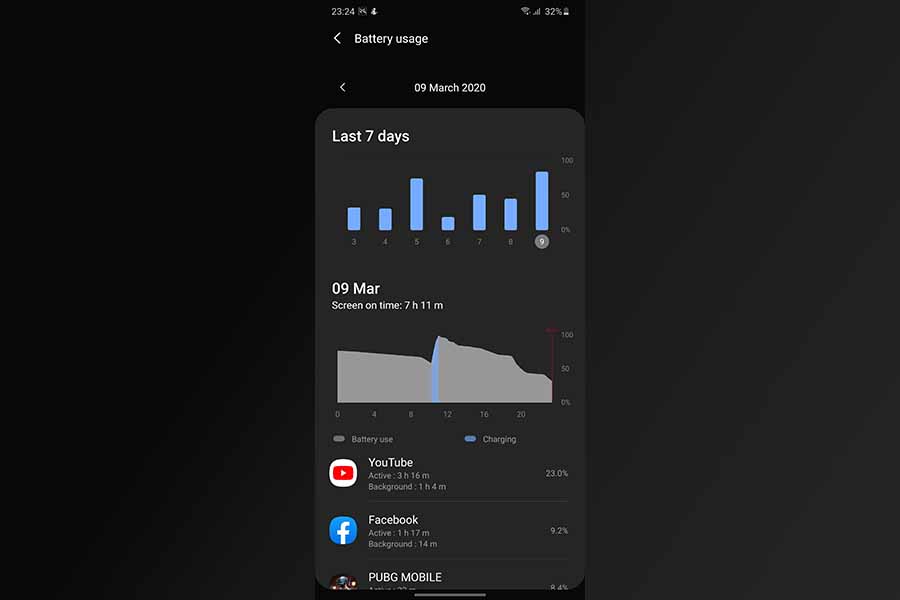
Samsung Galaxy S20, S20+ Review - Verdict
So… that’s it. That’s our review of the Samsung Galaxy S20 and S20+. These are the most “upgraded” launches between any two-consecutive iterations of the company’s flagship ‘S’ series of phones. With so many taglines like 5G, smooth display, space zoom embedded into the phones’ DNA, the S20 & S20+ have some big promises to keep up to. In most cases, the phones prove their worth, whereas it’s evident that Samsung is just throwing some impractical or rather less-practical stuff at the audience just for the sake of amusement. After all is said and done, the S20 and S20+ are still some of the most stellar phones out there and I’ve enjoyed my every second with them.
Samsung Galaxy S20, S20+ - Pros & Cons
Pros:- Sleek design & so comfortable to use
- Bright, vivid, & smooth 120Hz display with minimal bezels
- Some of the most innovative camera set up in modern times
- Great battery life despite such a power-hungry display
- No flagship-grade 45W fast charging
- Performance is a little compromised on the Exynos variants
- 30X Space Zoom & 8K recording is far from ideal at this point
- Omission of features like a headphone jack, heart rate sensor, & variable aperture lens
Article Last updated: March 18, 2020

![Best Laptops to Buy in Nepal at Every Price Segment [Updated]](https://media.gadgetbytenepal.com/2025/11/Best-Laptops-to-Buy-in-Nepal-at-Every-Price-Segment-2025.jpg)