Why Trust Gadgetbyte?
At Gadgetbyte, we invest substantial hours into rigorously testing each product or service we review, guaranteeing that you make informed purchases. Learn more about our testing process.
Review Overview
3.8
Design & Build
8/10
Display
7.5/10
Performance
8.5/10
Back Cameras
7/10
Front Camera
7/10
Software & UI
7/10
Battery
9/10
Value for Money
7.5/10
POCO M4 Pro 5G is a great upgrade over the lackluster M3 Pro that was launched a while back—to the point where we gotta ask ourselves if budget/mid-range 5G phones are finally getting better. Yet, the M4 Pro fails exactly where most other POCO phones do: software and cameras.
Hey guys, today I have brought you my final verdict on the POCO M4 Pro 5G in this review, after having used it for a couple of weeks now. Like I mentioned in our early impressions of the phone, the M4 Pro is a much better phone compared to its predecessor—even though the latter launched only a few months ago.
POCO M4 Pro 5G Specifications:
- Body: 75.78 x 163.56 x 8.75mm, 195 gm, Polycarbonate build, IP53 rated
- Display: 6.6-inches “Dot Display” IPS LCD panel, 90Hz refresh rate, Up to 240Hz touch sampling rate, DCI-P3 gamut, Gorilla Glass 3
- Resolution: FHD+ (2400 x 1080 pixels), 20:9 aspect ratio, 399 PPI
- Chipset: MediaTek Dimensity 810 5G (6nm Mobile Platform)
- Memory: 4/6GB LPDDR4X RAM, 64/128GB UFS 2.2 storage (expandable)
- Software & UI: Android 11 with MIUI 12.5 for POCO on top
- Rear Camera: Dual (with LED flash); – 50MP, f/1.8 primary sensor – 8MP, f/2.2 ultra-wide camera, 119º FOV
- Front Camera: 16MP f/2.45 sensor (punch-hole cutout)
- Audio: Stereo speaker setup, 3.5mm headphone jack
- Security: Side-mounted fingerprint sensor, Face unlock
- Sensors: Accelerometer, Ambient Light, Gyro, Electronic Compass, IR Blaster
- Connectivity: Dual-SIM (Nano), WiFi 802.11 a/b/g/n/ac (Dual-band), Bluetooth 5.1, GPS / AGPS / Glonass / Galileo, USB Type-C, 4G LTE, 5G
- Battery: 5000mAh with 33W Pro fast charging (33W adapter provided)
- Color Options: Cool Blue, Power Black, POCO Yellow
- Price in Nepal: N/A (not launched yet)
- EUR 229 (4/64GB) | EUR 249 (6/128GB)
POCO M4 Pro 5G Review:
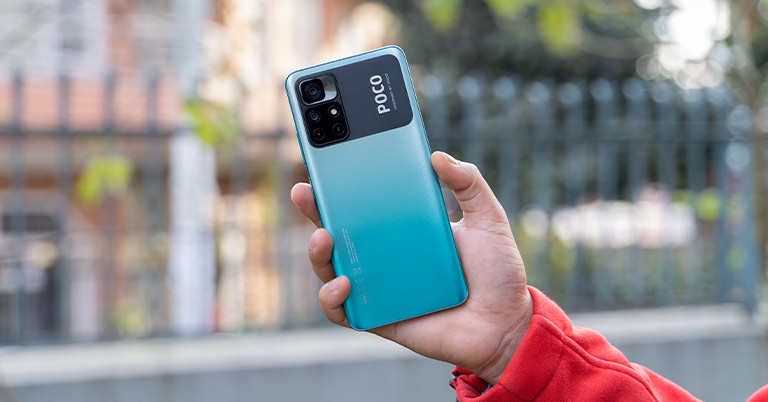
Anyway, you might be aware that the new Redmi Note 11 5G that's currently exclusive to the Indian market is a basic rebrand of the POCO M4 Pro. Besides the big black envelope encasing M4 Pro’s camera module, these two phones look the same as well.
Design & Build
- 75.78 x 163.56 x 8.75mm, 195 grams
- Glass front, polycarbonate back/frame
- IP53 certified against dust/splash damage
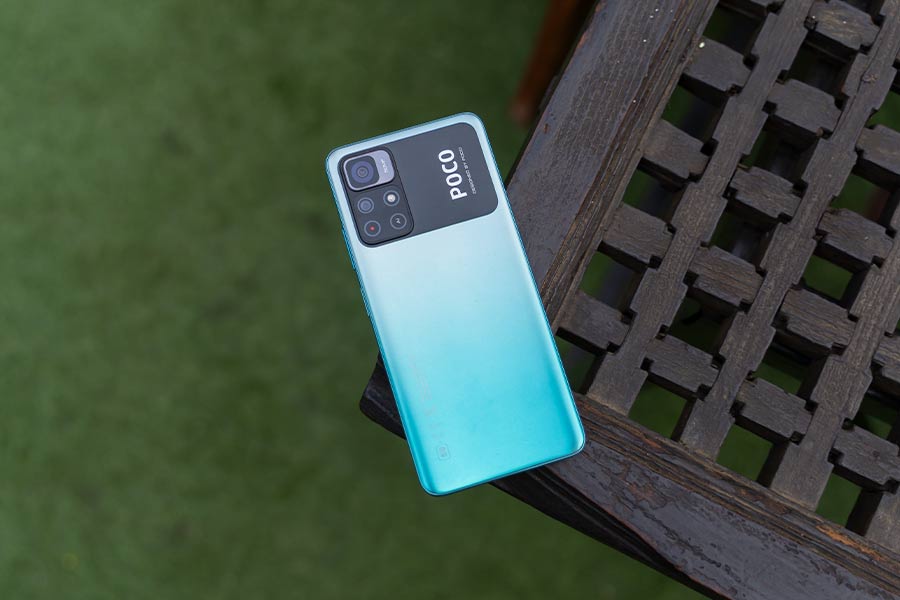
Moving on, its color options are reminiscent of the POCO M3 Pro too—but the matte finish on this Cool Blue variant is a big sigh of relief. Not only does it make the phone less resistant to smudges and fingerprint marks, but it sort of looks a bit premium too.
The M4 Pro also has an official IP53 rating. As a result, it should handle minor splashes without any trouble. At 195 grams, I found it difficult to hold it one hand for a long-time though. Still, the buttons on the right are quite accessible whereas the power button also doubles as a fingerprint scanner. As you’d expect, it is both fast and accurate.
Display
- 6.6-inches FHD+ IPS LCD panel
- 90/240Hz refresh/touch sampling rate
- Gorilla Glass 3, DCI-P3 color gamut
Over on the front, this 6.6-inch display is just marginally bigger than its predecessor. Yet, this is still an LCD panel with an FHD resolution and a 90Hz adaptive refresh rate. That being said, POCO has switched from sRGB to DCI-P3 color space here, resulting in richer colors.
Therefore, the difference is quite noticeable when toggling through the three display profiles. Colors look punchier on the Vivid and Saturated mode—both of which use the DCI-P3 color space, compared to the Standard mode that relies on sRGB.
This display also feels a lot smoother to use because of the increased touch-sampling rate. That being said, I wished it were a little brighter as it fails to maintain decent visibility outdoors.
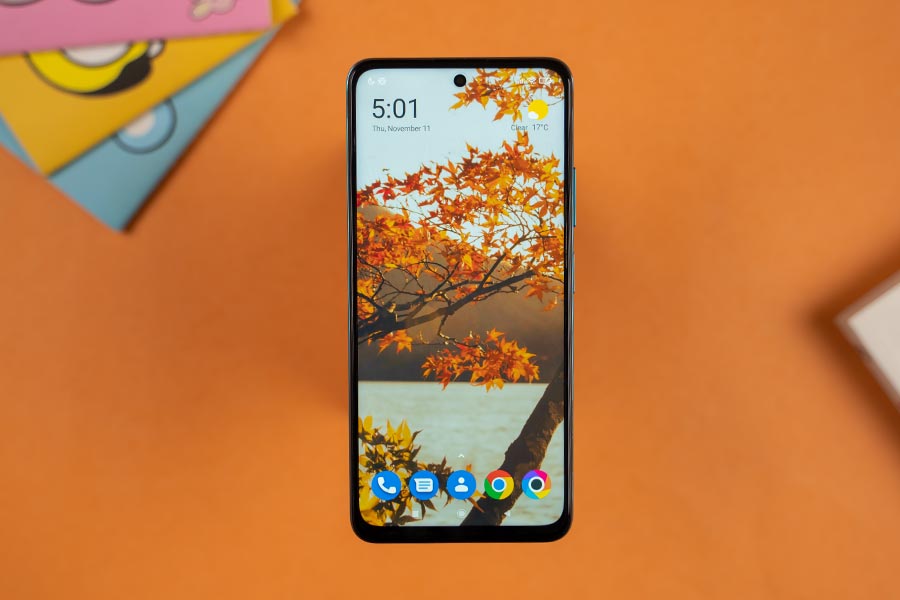
You can even stream HD content from your favorite streaming platform here thanks to the Widevine L1 certification. I recently finished watching Netflix Original Arcane on my POCO M4 Pro and don't have much complaint about how this display handles colors and contrast. I know an AMOLED panel would’ve been even better—but for an LCD panel—it doesn’t disappoint.
Stereo speakers
Adding to the multimedia experience is the stereo speaker setup, which was absent in its predecessor. The audio sounds quite balanced and I also like how it handles bass and highs. That being said, it doesn’t get very loud.
Performance
- Octa-core MediaTek Dimensity 810 5G SoC (6nm)
- 4/6GB LPDDR4X RAM, 64/128GB UFS 2.2 storage (expandable)
- Android 11 with Xiaomi's MIUI 12.5 for POCO on top
Under the hood, the phone packs Dimensity 810 5G chipset which is MediaTek’s first chip to be based on TSMC's 6nm process. It's basically an overclocked version of the Dimensity 700 that powered the M3 Pro, with a more energy-efficient design.
Here, my review unit of the POCO M4 Pro 5G has 6GB of RAM and 128GB of storage whereas it is also available in a 4/64GB configuration. On top of the expandable storage, you can assign an additional 2GB of RAM using the extended memory feature as well.
Despite this, I'm unsatisfied with M4 Pro’s RAM management. At times, apps tend to reload even when there are only a handful of other apps running in the background.
Gaming experience
Other than that, Dimensity 810 is powerful enough to handle all of your normal day-to-day tasks and also some gaming. The gameplay was smooth when playing PUBG Mobile at Smooth graphics. Similarly, COD Mobile was playable at Medium Graphics and High Frame Rate without any hiccup. But as expected, the phone struggles with graphics-demanding titles like Genshin Impact.
Moving on, while POCO has hinted at its own UI to arrive by the end of 2021, the M4 Pro still runs on custom MIUI 12.5 based on Android 11. And the phone comes with tons of pre-installed apps and games, which fortunately can be uninstalled. I don't like how the dark mode still has an issue with apps that use system settings by default though.

Because of this, I need to manually turn off system-wide dark mode settings (Settings > Display > Dark Mode > More Dark Mode options) on apps like Facebook and Spotify.
Enhanced haptics
Regardless, I'm quite fond of the new X-axis linear motor, which performs way better than the old coin vibration motor. Whether you are typing or adjusting volume with the volume rocker, the M4 Pro’s superior haptics are quite apparent.
Cameras
- Dual-camera setup at the back
- (50MP main, 8MP ultrawide)
- 16MP selfie camera (punch-hole)
Before getting to the cameras, there are a couple of things that I want to point out first. This time, POCO has dropped the gimmicky 2MP cameras for a more useful ultrawide camera instead. That being said, the company has misleadingly designed the camera array to fool you into believing that there's a quad-camera setup here.
Anyway, to test the camera capability of the POCO M4 Pro, I put it up against the Realme 8i since both of them sport a 50MP primary camera.
Normal Images
As you can see in these samples, the images come of drastically different from these phones.
The pictures from the M4 Pro have a warmer hue with relatively true-to-life colors. On the other hand, Realme 8i's photos look more saturated and vibrant.
Also, I noticed that POCO struggles with details on close-up shots. It does take better photos in some instances, but they are few and far between.
Wideangle Images
The ultrawide camera from the M4 Pro manages to deliver better colors compared to the primary camera. However, they’re lacking in terms of details.
Portrait Images
Moving on, it delivers better edge detection under portrait mode even without a dedicated depth sensor.
That being said, the portrait images are let down by their overall hazy quality, pale colors, and bad exposure.
Nighttime Images
Getting to low-light shots, the results look identical from both phones.
Yet, with night mode turned on, Realme once again beats POCO with better exposure control and detail retention.
The M4 Pro does capture light better, but much of the detail is lost trying to reduce the noise.
Selfie Images
In terms of selfies, the ones from POCO M4 Pro have higher contrast while Realme 8i’s images come off looking soft.
Overall, I believe that the M4 Pro’s cameras are let down by unoptimized software.
It can take decent photos but it's just not consistent enough. Most of the time, I also noticed that Auto HDR doesn’t work as it should here.
Battery
- 5000mAh battery with 33W fast charging
Despite the subpar camera, I have no complaints about the battery life on this phone. With a big 5000mAh battery onboard, I was able to get up to 9 hours of screen on time under normal usage. I mostly streamed contents off of Netflix/YouTube, scrolled through social media, and played some light games as well. Its charging speed is pretty swift too.
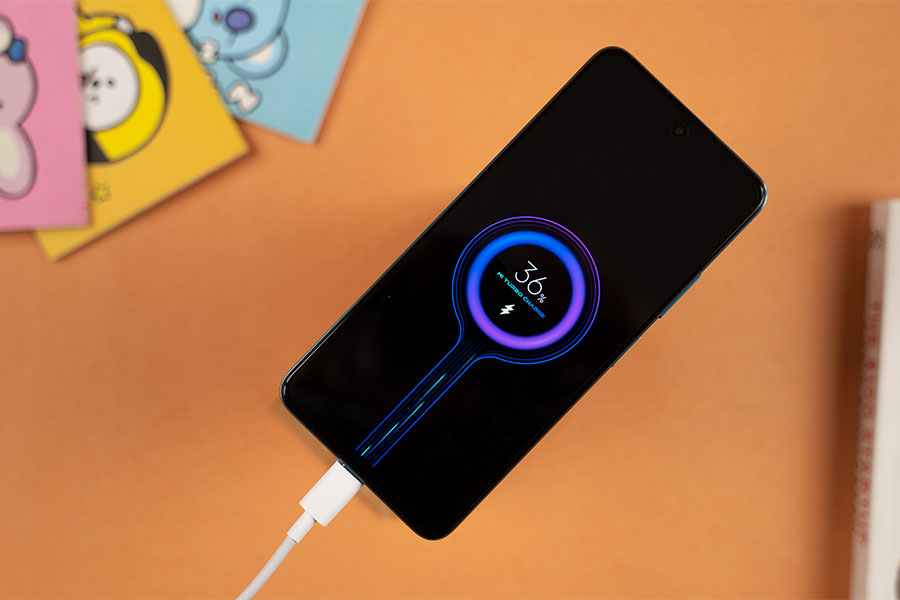
The 33W charger that comes inside the box takes a little more than an hour (±5%) to fill up this battery from 0 to 100%.
POCO M4 Pro 5G Review: Conclusion
Overall, the POCO M4 Pro 5G is a much better phone than its predecessor for an additional 50 Euro. It brings a decent 90Hz screen, better performance, stereo speakers, great battery life, and a faster charging speed—which makes it a decent offering given that the phone also brings 5G at a midrange price point.
Yet, you wouldn’t want to get the M4 Pro specifically for its performance and camera. If you want all of those and can skip on 5G, the POCO X3 Pro and Redmi Note 10 Pro Max make more sense instead.
- Watch our review video of the POCO M4 Pro 5G (Redmi Note 11T 5G).
Pros:
- IP53 dust-splash resistant
- Smoother 240Hz touch sampling rate
- Decent stereo speaker setup
- Excellent performance for the price
- Terrific battery endurance
Cons:
- RAM management troubles in the base model
- Most MIUI issues still remain unsolved
- Inconsistent cameras, weak auto-HDR
- Not the best value-for-money
Article Last updated: November 23, 2025