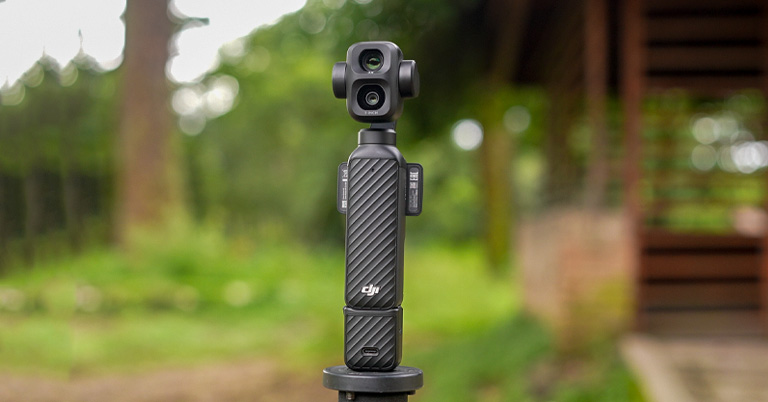
DJI’s Pocket 4P delivers an impressive run-and-gun shooting experience with strong low-light video, a useful 3× telephoto camera, and excellent gimbal stabilization.
Why Trust Gadgetbyte?
At Gadgetbyte, we invest substantial hours into rigorously testing each product or service we review, guaranteeing that you make informed purchases. Learn more about our testing process.
Review Overview
4.4
Low-Light Performance
9.4/10
Telephoto Camera
8.9/10
Stabilization and Tracking
9/10
Audio and Mic Support
9.4/10
Battery and Charging
8.7/10
The DJI Pocket 4P stands out with its excellent stabilization, strong low-light performance, sharp 3x telephoto camera, and easy run-and-gun shooting experience. Its lack of a native ultrawide camera and 3K limit in vertical mode are minor drawbacks, but for the price, it is one of the best compact video cameras for creators.
Design and Portability
8.6/10
Display and Controls
9.2/10
Software and UI
8.9/10
Video Quality
8.7/10
For years, action cameras like GoPro's have been a popular choice for vlogging, and it’s easy to see why. They’re small, convenient and easy to carry almost anywhere. But that traditional wide-angle action-camera look has its limitations, especially when you want to bring a product closer to the lens, shoot portraits or simply create something that doesn’t look like every other action-camera video.
That’s where DJI’s Pocket cameras started making things interesting. Autofocus, mechanical gimbal stabilization and eventually a 1-inch sensor gave creators much more flexibility without forcing them to carry a proper camera and gimbal setup. And with the Pocket 4P, DJI has taken that idea even further by adding a second camera, a dedicated 3× telephoto alongside the main wide-angle lens.
I’ve been excited to try this camera since it was teased, and over the past month, I’ve taken it travelling, carried it to launch events, shot Instagram Reels with it and compared it side by side with my iPhone 18 Pro Max. And because I normally work with much larger camera setups too, I was especially curious to see how much of that experience DJI could squeeze into something this small.
After using it extensively, I have plenty to say about where the Pocket 4P genuinely impressed me, where my iPhone is still more convenient and where DJI still has room to improve. So, let’s get into it.
DJI Pocket 4P Specifications:
- Main camera: 1-inch CMOS, 20mm equivalent, f/2.0
- Telephoto camera: 1/1.28-inch CMOS, 60mm equivalent, f/1.8, 3× optical zoom
- Maximum zoom: Up to 12×
- Video: Up to 4K 60FPS
- Vertical video: Up to 3K 60FPS
- Stabilization: 3-axis mechanical gimbal
- Tracking: ActiveTrack 8.0
- Display: 2-inch OLED
- Storage: 103GB built-in
- Battery: 1,545mAh
- Weight: Around 230g
DJI Pocket 4P Price in Nepal
The DJI Pocket 4P comes in two packages in Nepal, the Standard Combo and the Vlog Combo. You get the same camera in both, so the difference mainly comes down to the accessories included.
| DJI Osmo Pocket 4P | Price in Europe | Price in Nepal |
|---|---|---|
| Standard Combo | €599 | Rs. 112,000 |
| Vlog Combo | €689 | Rs. 124,000 |
Personally, I’d lean toward the Vlog Combo if you’re building your setup from scratch. For an additional Rs. 12,000, you get the wireless mic, external display/controller and mini tripod, which together make the Pocket 4P a much more complete solo-shooting setup. If you already own a compatible microphone and tripod, however, the Standard Combo makes more sense.


One thing to remember is that neither package includes the battery handle, so that still needs to be purchased separately.
DJI Pocket 4P Review:
What’s in the Box?
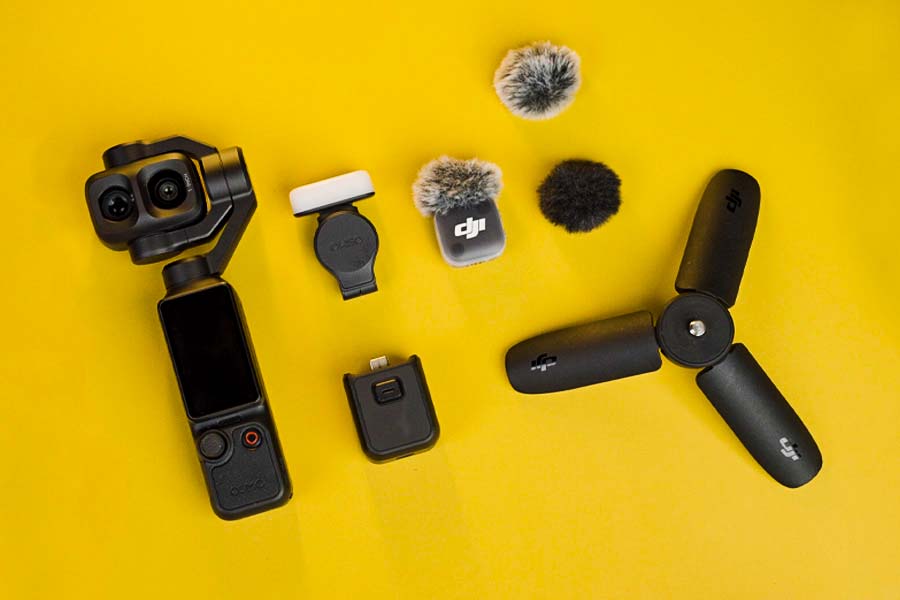
The Standard Combo already gives you most of the basics you need to start shooting. You get the Pocket 4P itself, detachable fill light, handle with a 1/4-inch tripod thread, USB-C cable, wrist strap and carrying pouch.
The Vlog Combo adds the accessories that make the setup much more useful for solo creators, particularly the DJI Mic Mini 2 transmitter, mini tripod and external FrameTap display/controller.
| Box contents | Standard Combo | Vlog Combo |
| DJI Osmo Pocket 4P | Yes | Yes |
| Detachable fill light | Yes | Yes |
| Handle with 1/4-inch tripod thread | Yes | Yes |
| USB-C to USB-C PD cable | Yes | Yes |
| Wrist strap | 1 | 2 |
| Portable carrying pouch | Yes | Yes |
| DJI Mic Mini 2 transmitter | No | Yes |
| Mic windscreen, clip and magnet | No | Yes |
| Mic front covers | No | Yes |
| Mic charging cable | No | Yes |
| FrameTap external display/controller | No | Yes |
| FrameTap charging cable | No | Yes |
| Mini tripod | No | Yes |
| Larger carrying bag | No | Yes |
The 1/4-inch thread on the handle is particularly useful because you can mount the Pocket 4P on normal tripods and other standard camera accessories without needing a special adapter. And the mini tripod included with the Vlog Combo might look simple, but it quickly becomes useful when you want to place the camera on a desk, use ActiveTrack or shoot yourself from a distance.
Design
The first time I picked up the Pocket 4P, it felt like an interesting middle ground between a smartphone and a handheld gimbal. At around 230 grams, carrying it around Kathmandu, taking it to launch events or throwing it inside my bag while travelling never felt like an extra burden. And as someone who regularly works as a videographer, that feels refreshing.
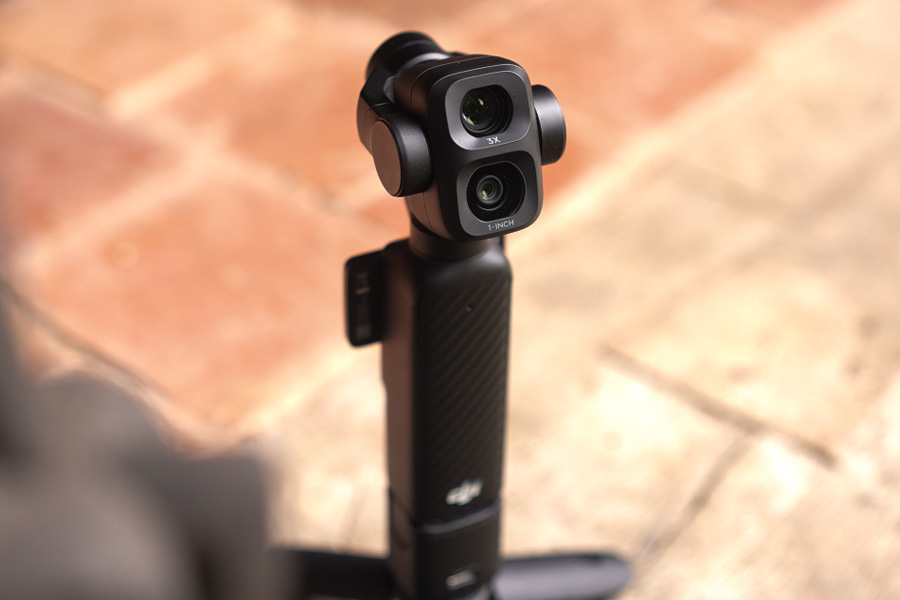
My usual setup can mean carrying a Sony A7S III with a Sigma 24-70mm f/2.8 lens, extra batteries, lenses and a gimbal, so the Pocket 4P feels dramatically easier to live with. I could carry the camera, wireless mic, tripod and a few accessories without feeling like I had packed a full production setup.
Compared to my iPhone 18 Pro Max, the weight difference is not huge, but the experience of holding them is quite different. The iPhone is thinner and fits better in a pocket, while the narrow body of the Pocket 4P gives me a better grip for longer shooting sessions. If I am walking around recording continuously for 20 or 30 minutes, I would rather hold the Pocket 4P. But if I’m heading outside without a bag and just want something in my pocket, the iPhone is obviously more convenient.
4P vs Pocket 4
Despite adding a second camera, the Pocket 4P is not dramatically bigger than the regular Pocket 4. The main difference is the slightly larger camera head, which now houses both the 20mm main and 60mm telephoto cameras.
In hand, it still feels compact and easy to carry. More importantly, that 3× camera gives you much more flexibility for portraits, product shots, events and travel B-roll without sacrificing much portability.
Display
The 2-inch OLED display is small, but I found it bright enough to use comfortably even outdoors in sunny conditions. Framing shots, checking exposure and navigating the camera were never difficult for me during daytime travel or event shoots.
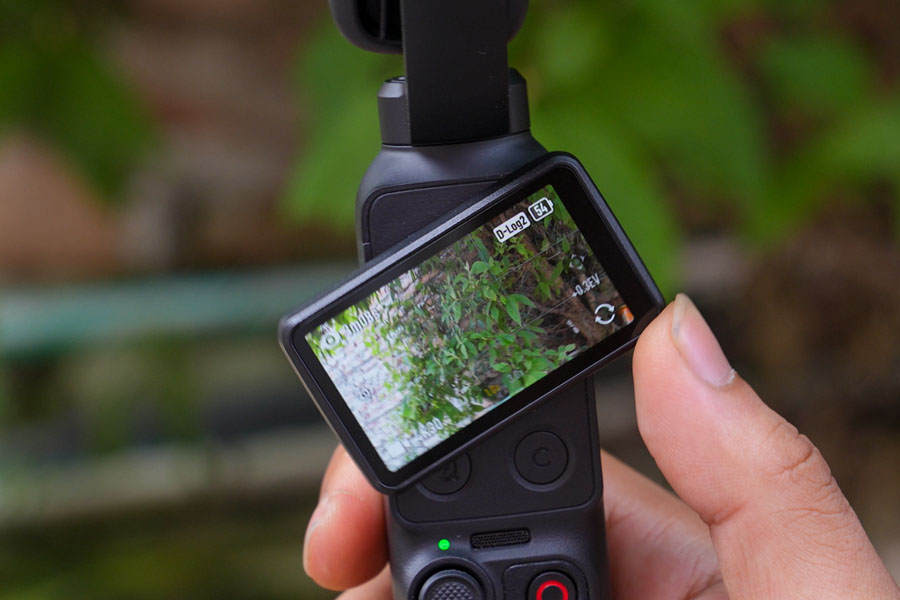
One thing I really like is how the flipping display is tied directly to shooting orientation. Flip the display horizontally and the camera switches to landscape shooting, then rotate it vertically and it automatically changes to vertical mode. That makes jumping between normal videos and Instagram Reels much quicker.
Compared to an iPhone, the screen obviously feels tiny, especially when checking fine detail, but for actual shooting I rarely felt like I needed anything larger.
Physical Controls
DJI has kept the physical controls simple, but they are genuinely useful. The joystick controls the gimbal movement and feels very smooth in use. Double-pressing it quickly brings the camera back to its original forward-facing position, while pressing it three times flips the camera around into selfie mode.
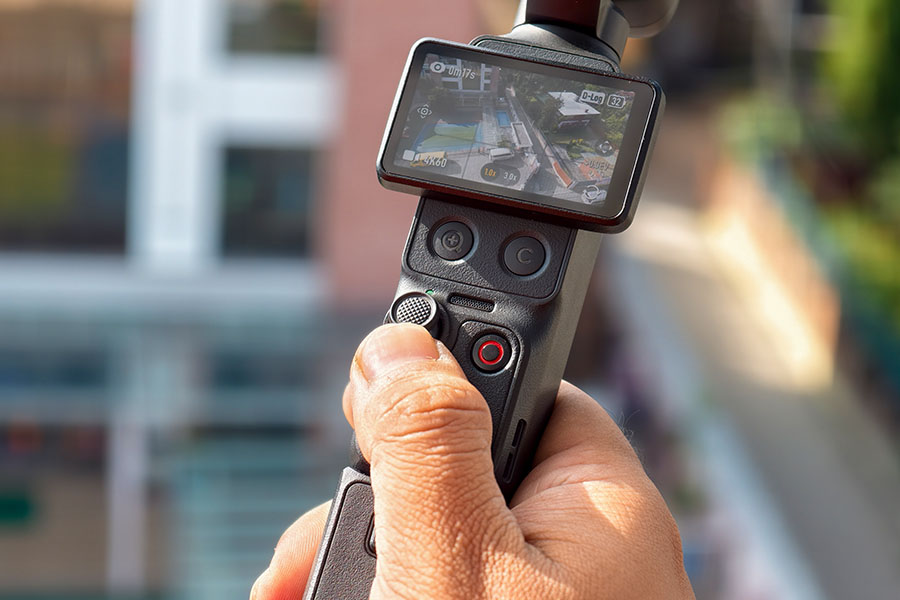
You can also adjust the way the joystick and gimbal respond from the settings, including movement speed and smoothness, depending on whether you want faster reactions or slower, more cinematic motion. There is also the combined record and power button along with dedicated zoom and customizable controls. I like having these physical shortcuts because I don’t have to depend on the touchscreen for every basic action, especially when I’m moving quickly at an event.
UI
Most of the actual camera settings are controlled through the touchscreen, and DJI has done a good job keeping everything easy to navigate. Resolution, frame rate, exposure, tracking, color profiles and other important options are only a few swipes or taps away.
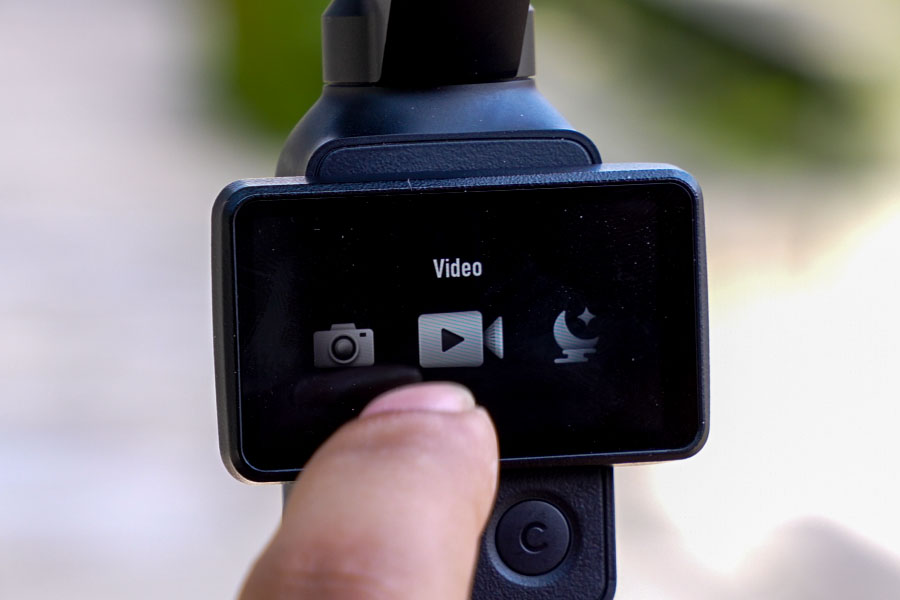
Even while shooting at events, I rarely felt like I had to dig through menus to find something. Once you understand DJI’s swipe gestures, the interface becomes very intuitive. That is important for a camera like this because the entire idea is speed. If I have to spend too much time changing settings, it defeats the purpose of carrying such a compact run-and-gun camera in the first place.
App Control
The Pocket 4P needs to be activated through the DJI Mimo app first, but after that, I mainly use Mimo for quickly moving footage to my phone. I can transfer clips, do a quick edit and post them straight to Instagram or other social platforms without going through a laptop, which is really handy.For fast social-media content, this App makes the Pocket 4P workflow much more convenient.
Gimbal Modes
The Pocket 4P also gives you several gimbal modes depending on the type of movement you want. Follow is the mode I used most often because it smoothly follows your direction while keeping the footage stable, which works well for walking shots and normal vlogging.
Tilt Lock keeps the vertical angle fixed while allowing horizontal movement, making it useful when you want a more controlled horizon. Then there is FPV, which gives the gimbal more freedom to follow your movement across multiple axes for a more dynamic look, while FPV Flip can be useful when you want more stylized motion. I like having these different modes because they let me change the character of a shot without adding another gimbal or changing my entire setup.
Storage
The Pocket 4P comes with 103GB of built-in storage, which is something I really appreciate. Even if I forget to insert a memory card, I can still take the camera out and start shooting.
For Reels, quick event coverage or shorter shoots, 103GB can be enough on its own. But if you’re recording a lot of 4K footage, slow motion or full travel days, it can fill up fairly quickly, so thankfully you can also add a microSD card.
Compared to the iPhone, I prefer having expandable storage here. On the iPhone, once you fill your internal storage, you either have to start deleting files or move them elsewhere. With the Pocket 4P, I can simply swap in another card and keep shooting.
The iPhone still wins on workflow though because everything I shoot is already on the same device I use to edit and upload.
Accessories
The accessory ecosystem is another big advantage of the Pocket 4P. A lot of body-mounted and handle-mounted accessories from older Pocket setups can still be useful here, including expansion cages, tripod solutions and certain battery handles.
Camera-specific accessories are where compatibility changes because the Pocket 4P has a different dual-camera head. So things like ND filters, wide-angle attachments or protective pieces need to be made specifically for this model.
Fill Light
One accessory I actually appreciate is the detachable fill light, and the good thing is that DJI includes it even with the Standard Combo. It attaches directly to the camera and gives you a quick source of light when you are filming yourself indoors, shooting in a dim room or just need a little extra light on a subject. It is not going to replace a proper video light, but for close-up vlogging or quick product shots, it is surprisingly useful and saves you from carrying another small light in your bag.
External Display
The FrameTap external display/controller included with the Vlog Combo is particularly useful if you regularly shoot yourself from a distance. It lets you monitor the live feed, check framing and control the camera remotely, which means I don’t have to keep walking back to the Pocket 4P every time I want to check composition or start recording.
The display quality is good enough for framing and making sure everything is positioned correctly. For solo videos, interviews, product shots or even ActiveTrack setups, it is genuinely useful.
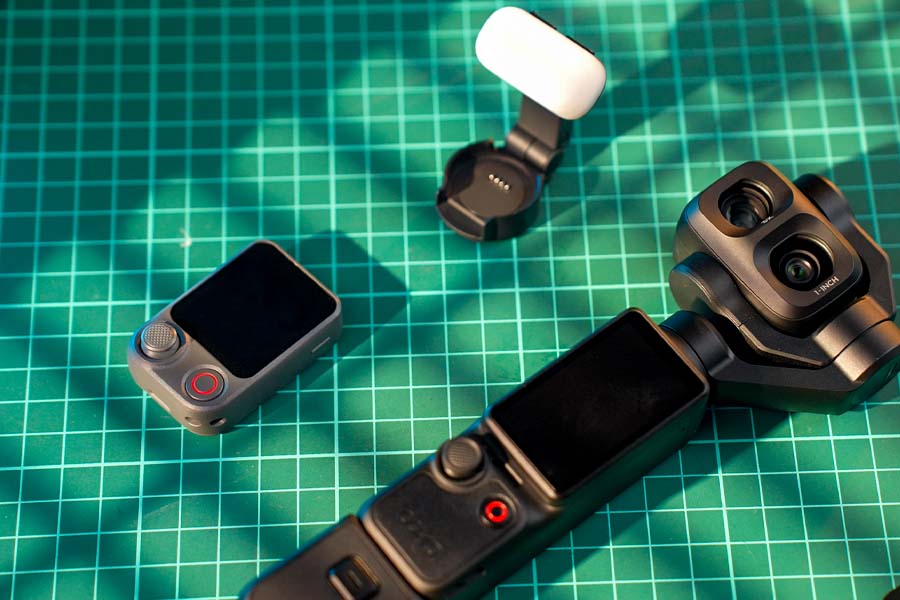
The connection is not perfect though. When the camera and controller have a clear line of sight and are within a reasonable distance, the feed works well. But if you move too far away or there are walls, doors or other interference between the two, the live feed can start lagging and the image quality can drop.
So I see it mainly as a framing and remote-control tool rather than something I would rely on for perfect long-distance monitoring.
DJI Mic Support
DJI’s wireless microphone integration is also really convenient. Compatible DJI microphones can connect directly to the Pocket 4P without requiring a separate receiver, which keeps the entire setup much cleaner.
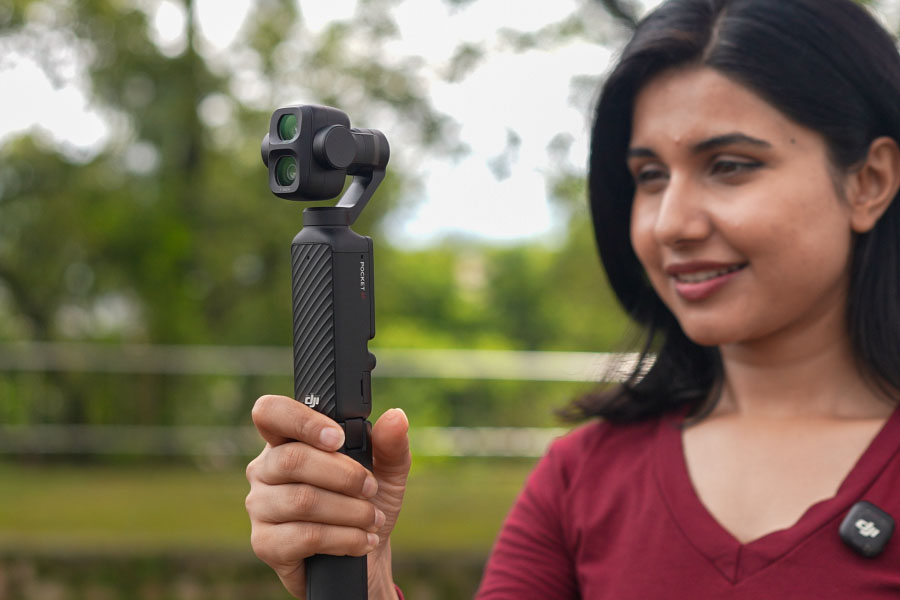
Pairing is quick, and once connected, the mic feels like part of the camera rather than another accessory hanging off the side. For vlogging, interviews or event coverage, that simplicity is excellent. However, direct wireless support is limited to compatible DJI Mic models, so if you already own an older DJI microphone, I would check compatibility before assuming it can connect receiver-free.
Video Quality
The Pocket 4P uses a 1-inch sensor with a 20mm f/2.0 lens, and in daylight, the footage looks excellent. I compared it side by side with my iPhone 18 Pro Max, which I still use a lot for Reels and casual vlogging, and honestly, both produce really good footage.
The iPhone generally looks slightly sharper and warmer straight out of the camera, which is great when I want something ready to upload immediately. DJI tends to lean cooler and sometimes gives my skin a slightly whiter tone.
The iPhone sometimes darkens the subject a little more aggressively to protect the highlights. In simple daylight scenes, the difference between the two isn’t always huge, but in more challenging lighting, the Pocket 4P starts showing its larger-sensor advantage.
Vertical Video
Vertical shooting is particularly important for me because a lot of my content ends up on Instagram Reels. On the iPhone, this is obviously very straightforward. I simply hold the phone vertically and shoot.
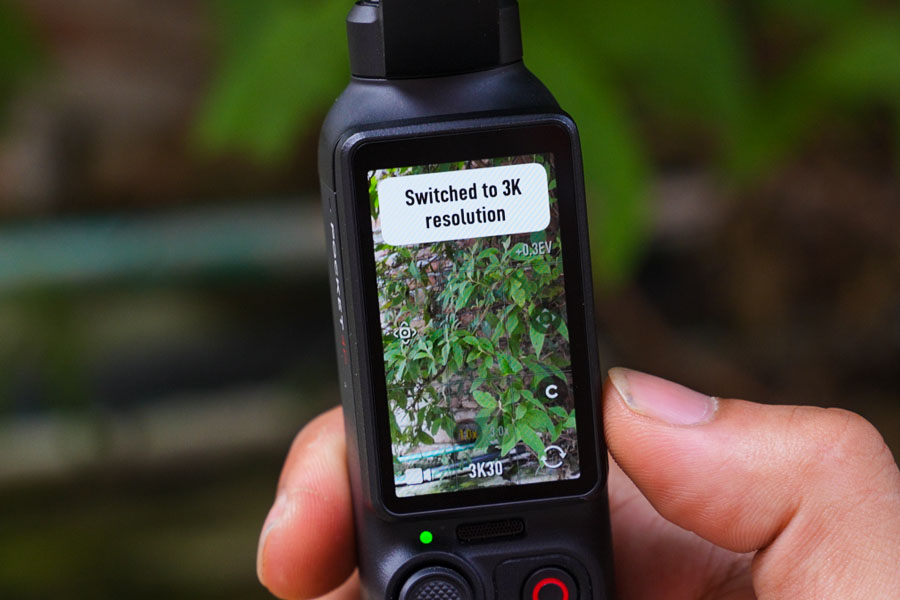
The Pocket 4P handles this differently. Flipping the display vertically automatically switches the camera into native vertical mode, but the resolution tops out at 3K. For most Reels, 3K is already more than enough.
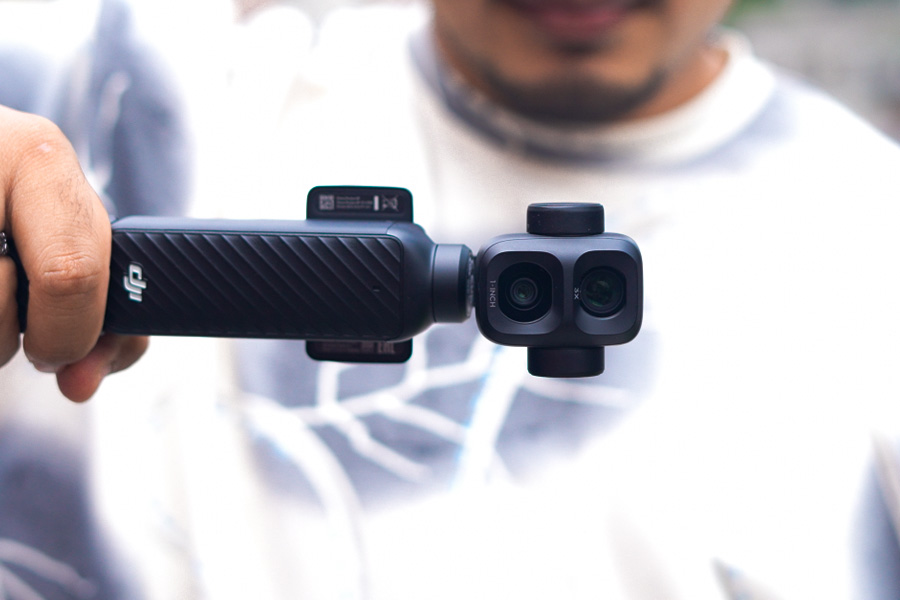
But if I want the highest possible quality, there is another way. I can physically rotate the entire Pocket 4P sideways and use the normal 4K recording mode while holding the camera vertically. Then I simply rotate the footage during editing.
It looks slightly strange while shooting, but it gives me proper 4K footage for vertical content instead of being limited to native 3K. So the iPhone is still easier, but the Pocket 4P gives you more flexibility if you’re willing to work around it.
Pro Video Controls
The Pocket 4P is easy enough for point-and-shoot use, but DJI also gives you plenty of manual control when you want to treat it more like a proper camera. In Pro mode, you can manually adjust exposure, white balance, color profile, film tone, focus mode and image adjustments.
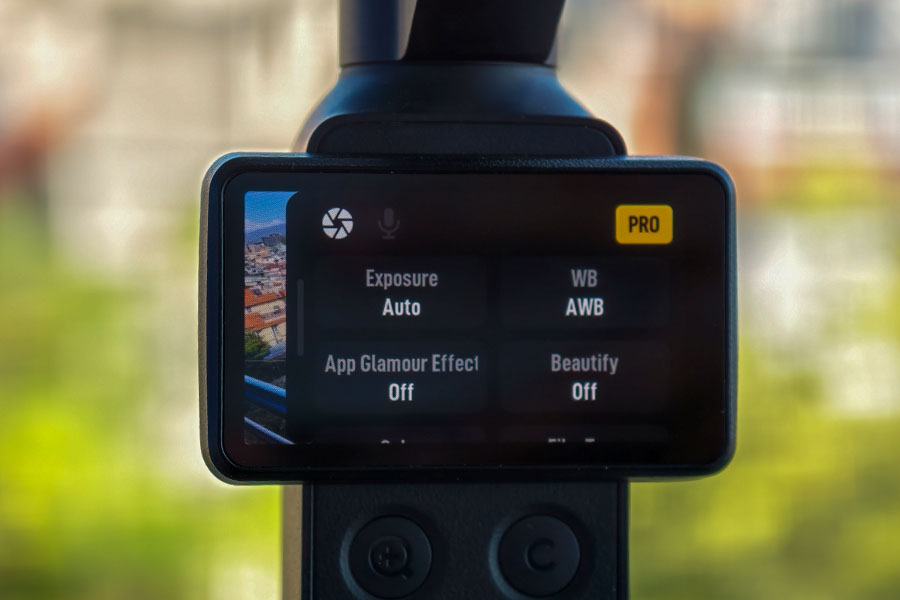
I found this particularly useful for product shoots and controlled lighting, where I wanted consistent exposure and color across multiple clips instead of leaving everything on auto.
The iPhone can also offer professional video controls, especially through Log recording and third-party camera apps, but DJI puts all of this inside a device designed entirely around shooting video. For me, it feels more natural to switch into manual control on the Pocket 4P.
3x Telephoto Camera
For me, the 3x telephoto camera is probably the biggest reason to choose the Pocket 4P over the regular Pocket 4. The 60mm equivalent lens gives you much tighter framing and more natural background separation, which works particularly well for products, portraits and B-roll.
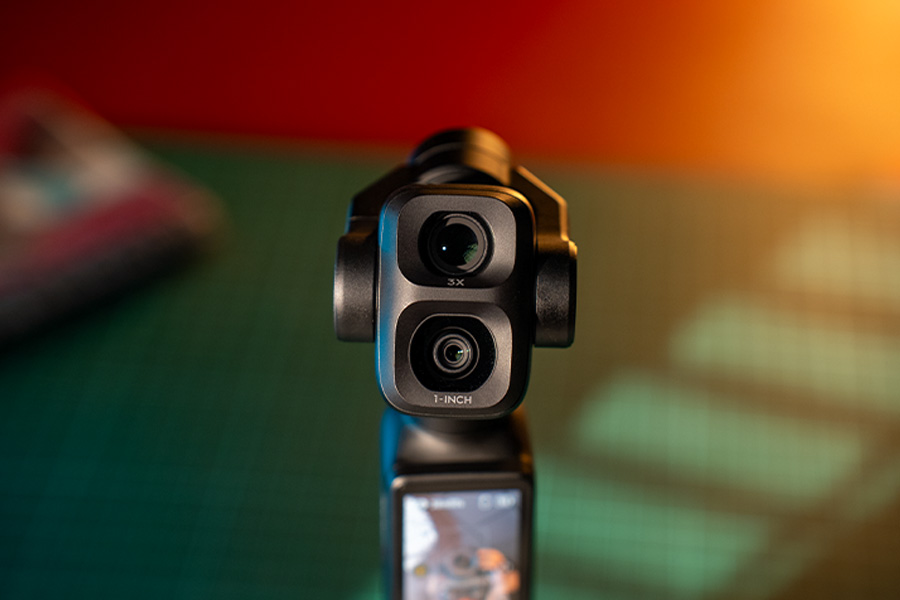
I used it quite a lot during events and while filming products, and the footage has a more traditional camera-like look than what I normally get from a smartphone telephoto camera. Compared to the 4x telephoto on my iPhone 18 Pro Max, the Pocket 4P also gives me noticeably sharper footage with better fine detail.
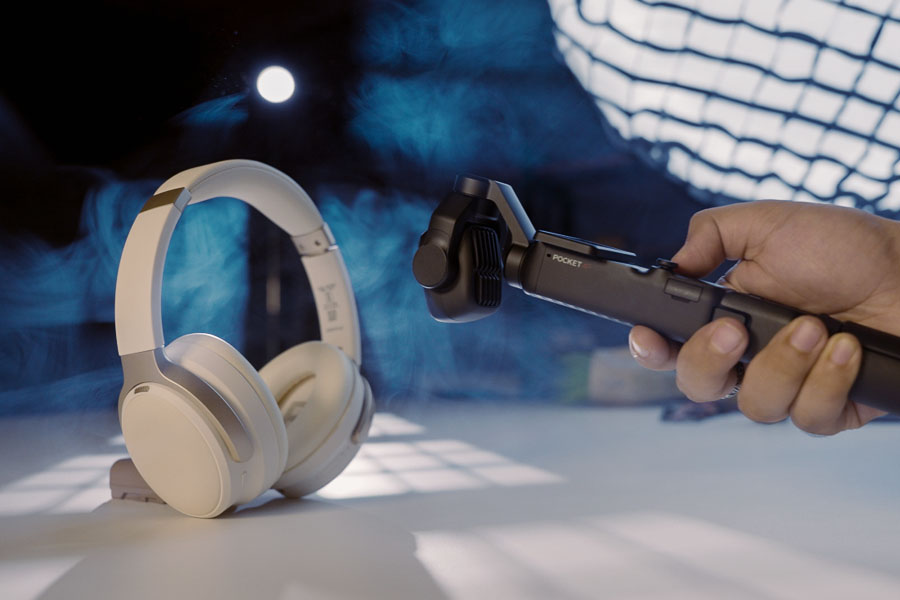
Add the telephoto compression, physical gimbal movement and more natural background separation, and the result feels cleaner and less processed overall. For product videos especially, I definitely prefer the look from the Pocket 4P.
No Ultrawide
One thing I definitely missed on the Pocket 4P was an ultrawide camera. The 20mm main lens is wide enough for normal vlogging, but if I’m shooting landscapes, architecture, group shots or very tight spaces, the iPhone is simply more flexible.
With the iPhone, I can switch to ultrawide instantly. DJI does offer a wide-angle accessory, but that is another attachment to carry and it can also be difficult to find in Nepal. So while DJI gives me the telephoto perspective I prefer for video, the iPhone still wins when I need to go really wide.
Stabilization
Both the iPhone and Pocket 4P produce very stable footage, but they achieve it in completely different ways. The iPhone uses optical and electronic stabilization and does an excellent job of removing shake during casual handheld shooting.
The Pocket 4P, however, has a proper three-axis mechanical gimbal, and that changes the character of the footage completely. Walking shots feel smoother, pans are more controlled, and slower movements have a more cinematic flow.
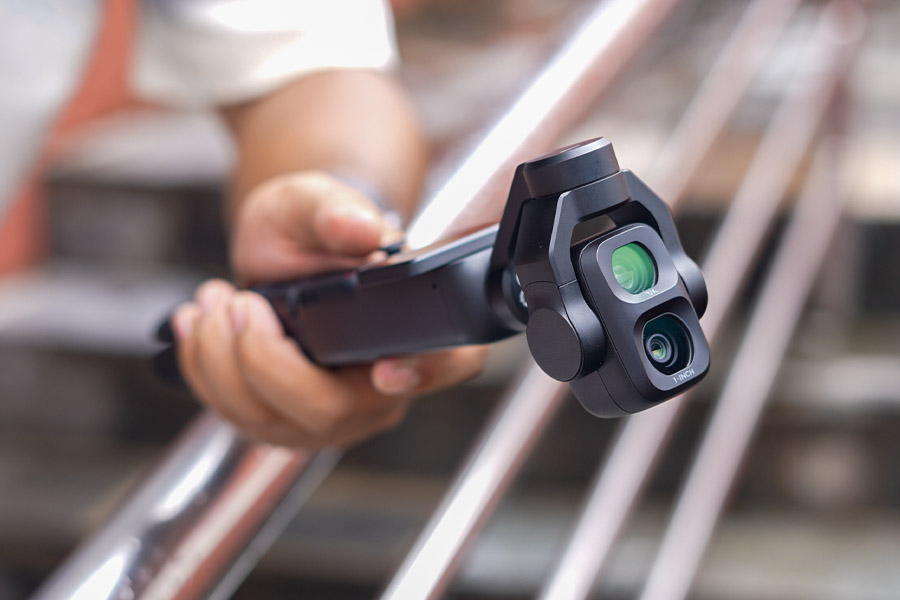
This became particularly noticeable when I was moving around a product or following someone. The iPhone gives me stable footage, but the Pocket 4P gives me footage that actually feels like it was shot on a gimbal. For event coverage, that alone saved me from carrying my Sony setup and a separate gimbal just for a few B-roll shots.
ActiveTrack
ActiveTrack is another feature I ended up using more than I expected. I can place the Pocket 4P on a tripod, select myself and let the camera physically follow me around.
For solo travel videos, demonstrations or Reels, this means I can get moving shots without needing someone behind the camera. It’s not going to replace a proper camera operator, but for solo creators it is genuinely useful.
Slow Motion
Slow motion is another area where both devices behave differently. The iPhone 18 Pro Max can shoot 4K slow motion at up to 120fps using the main camera. You can use the 1× view or the 2× crop from the same main sensor, but you cannot freely switch to the ultrawide or 4× telephoto while staying in that 4K 120fps mode. If you want the higher 240fps option, you need to drop down to 1080p.
The iPhone produces excellent slow motion when I keep the camera relatively steady, but when movement is part of the shot, I prefer the Pocket 4P.
Low Light
Low light is where I noticed the biggest difference against my iPhone. Thanks to the larger main sensor, the Pocket 4P captures cleaner footage with less noise and better detail once the surroundings get darker.
The difference becomes even more obvious while walking because the iPhone starts relying more heavily on processing and stabilization, which can make darker footage look softer or muddier.
During the day, both are very usable. After sunset, I would pick the Pocket 4P without hesitation.
D-Log and D-Log 2
You get both D-Log and D-Log 2 on the Pocket 4P, but they work slightly differently. D-Log 2 is available on the main camera and gives you more flexibility when recovering highlights and shadows during grading.
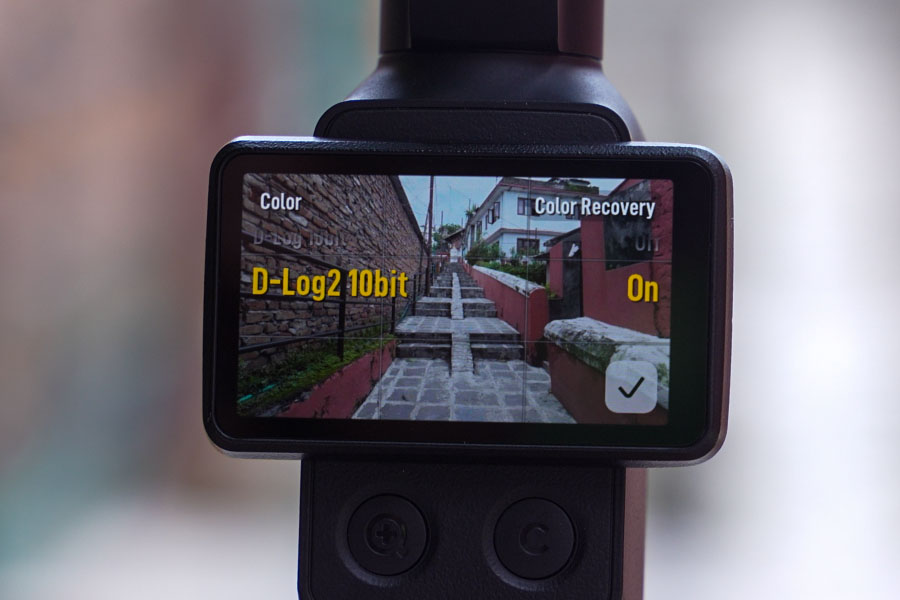
This becomes particularly useful in high-contrast scenes, like filming someone inside with a bright window behind them.
The telephoto camera does not support D-Log 2, so when you switch to 3x, you use the regular D-Log profile instead. Honestly though, I don’t think this is a major issue for most users because regular D-Log is already capable enough for proper color grading and gives you more flexibility when switching between both cameras. I would mainly use D-Log 2 when I know I am staying on the main camera and really want maximum dynamic range.
Photos
You can take photos with the Pocket 4P as well, and because of the larger sensors, the results can look surprisingly good. I particularly like the natural background separation from the telephoto camera for products and portraits.
But for photography, I still prefer the iPhone. It gives me ultrawide, main, telephoto, portrait mode and a much faster photo workflow all in one device.
The Pocket 4P feels very much like a video-first camera that also happens to take good photos, and I think that is exactly how it should be treated.
Battery
The Pocket 4P has a 1,545 mAh battery, and in my real-world use, I was getting roughly 2 to 2.5 hours while mostly shooting in 4K. For normal travel, short-form content or event B-roll, that was good enough for me. Charging is also quite fast. Using a 65W charger, it took me around 35 minutes to go from 0 to 100%, so even if I forget to charge it beforehand, a short top-up can get me back to shooting pretty quickly.
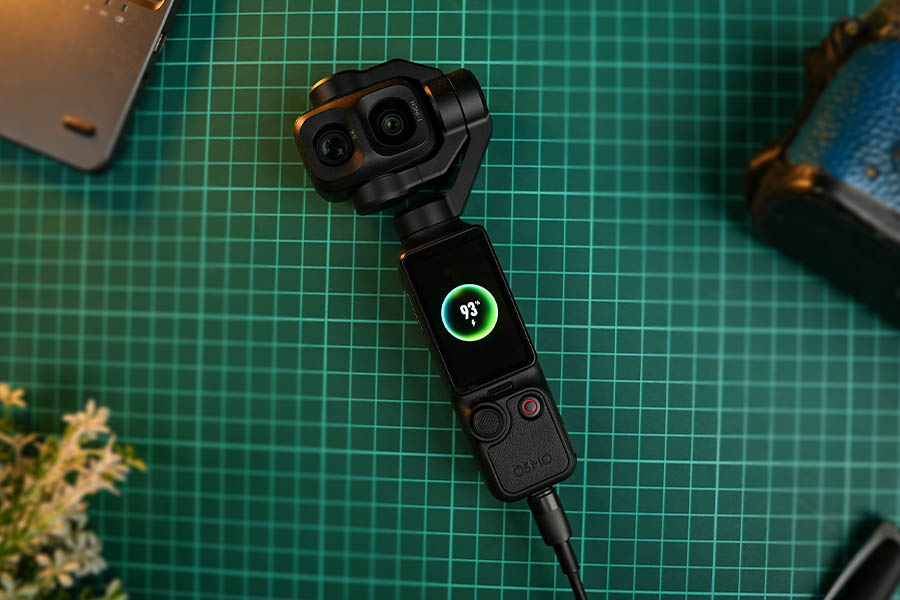
I was slightly disappointed that the Vlog Combo does not include a battery handle though. If you are shooting full events or travelling all day, I would definitely consider adding one. Some battery handles made for previous Pocket cameras can also still be useful depending on compatibility, so if you already own accessories from an older Pocket setup, you may not necessarily need to replace everything.
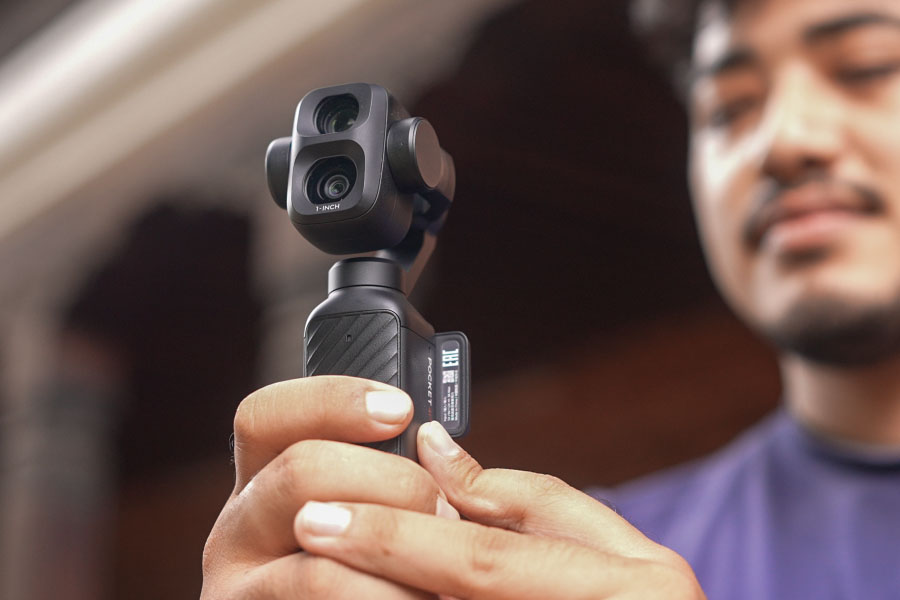
Compared to the iPhone, the phone naturally gives me longer recording endurance, but it is also doing everything else throughout the day, including calls, navigation, editing and uploading. With the Pocket 4P, I have a completely separate battery dedicated to shooting, which I actually appreciate during longer events.
DJI Pocket 4P vs iPhone 18 Pro Max
After using both side by side for a month, I don’t think there is one universal winner because they solve different problems.
The iPhone 18 Pro Max is still the king of convenience for me. I can shoot, edit and upload from one device, I have ultrawide, main and telephoto focal lengths available instantly, vertical shooting is effortless, and I don’t need to think about transferring footage.
DJI Pocket 4P vs Insta 360 Luna Ultra
The Insta360 Luna Ultra is probably the closest alternative to the Pocket 4P right now. On paper, it is actually very impressive. You get a similar 20mm + 60mm dual-camera setup, but Luna Ultra can shoot up to 8K30, and its 2-inch OLED display can detach from the body and work as a wireless monitor and remote. The camera body is also shorter, although it is noticeably wider in hand.
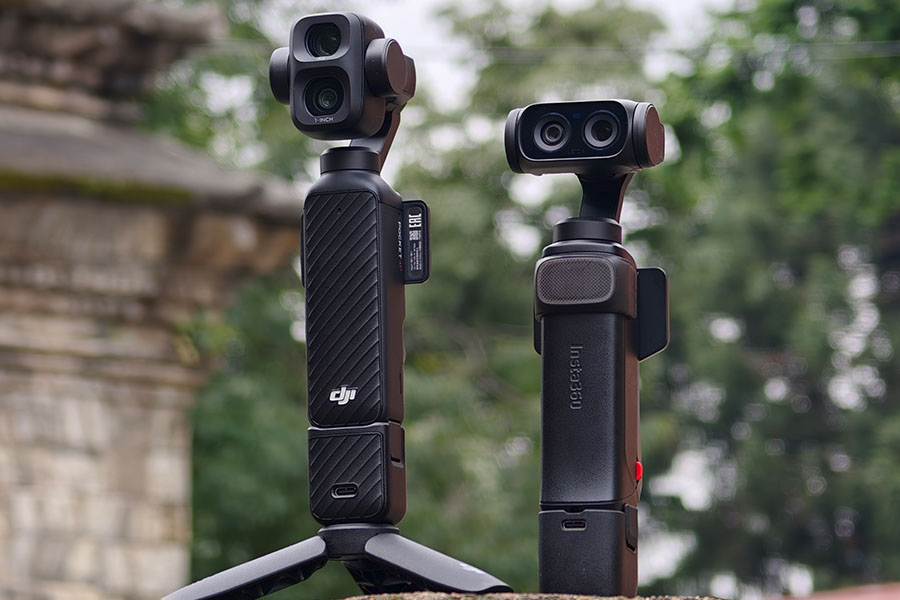
But after looking at both, I still prefer the overall camera experience of the Pocket 4P. Luna Ultra feels like a very ambitious first-generation product, while DJI has been refining Pocket cameras for years. The reference comparison I looked at also found the Pocket 4P more polished overall, with better dynamic range, highlight control, skin tones and more reliable tracking, although Luna Ultra can get surprisingly close in good lighting and even performs well in some low-light situations.
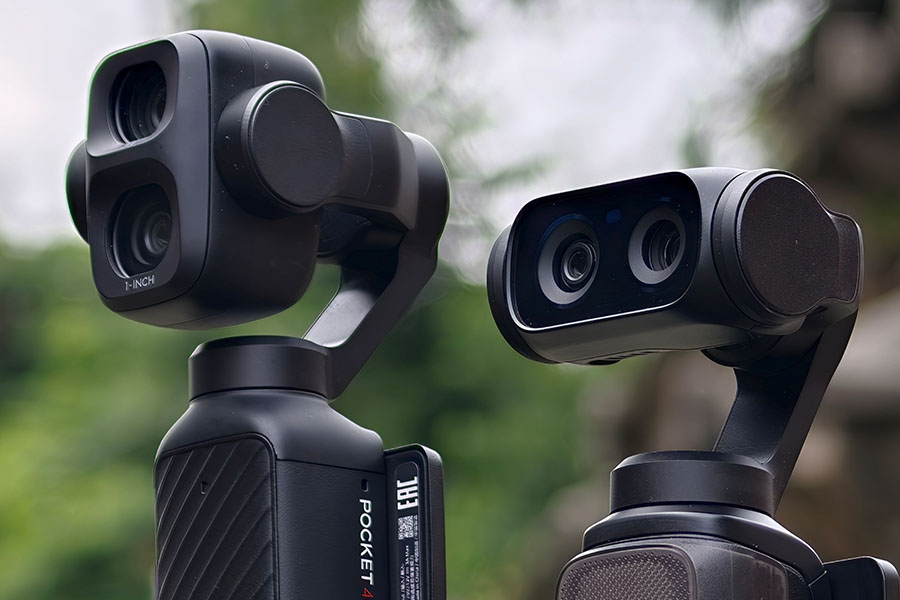
So Luna Ultra definitely has some advantages, especially 8K recording and that clever detachable screen, but I feel the software, controls and overall shooting experience still need a few more updates to feel as mature as DJI. For a first attempt, it is genuinely impressive, but right now I would still trust the Pocket 4P more for regular professional use.
Pocket 4P vs Luna Ultra vs iPhone 18 Pro Max
| Category | DJI Pocket 4P | Insta360 Luna Ultra | iPhone 18 Pro Max |
|---|---|---|---|
| Video | Up to 4K, excellent overall | Up to 8K30, 4K120 | Excellent 4K video |
| Stabilization | 3-axis gimbal | 3-axis gimbal | Optical + electronic |
| Telephoto | Sharp 60mm 3× | 60mm telephoto | 100mm 4× |
| Display | Flip OLED | Flip + detachable OLED | Large phone display |
| Vertical video | Up to 3K60 | Up to 4K30 | Native 4K |
| Tracking | Excellent ActiveTrack | Strong tracking | More limited |
| Workflow | Mature dedicated-camera workflow | Feature-rich, still less refined | Fastest shoot-edit-post |
| Main Strength | Overall shooting experience | Hardware innovation | Convenience |
Conclusion
So, which one should you buy? If you want the easiest workflow and don’t want to carry another device, get the iPhone 18 Pro Max. If features like 8K recording and a detachable display matter most, the Luna Ultra is the more adventurous option, although I still feel Insta360 has some polishing to do with the overall camera experience.
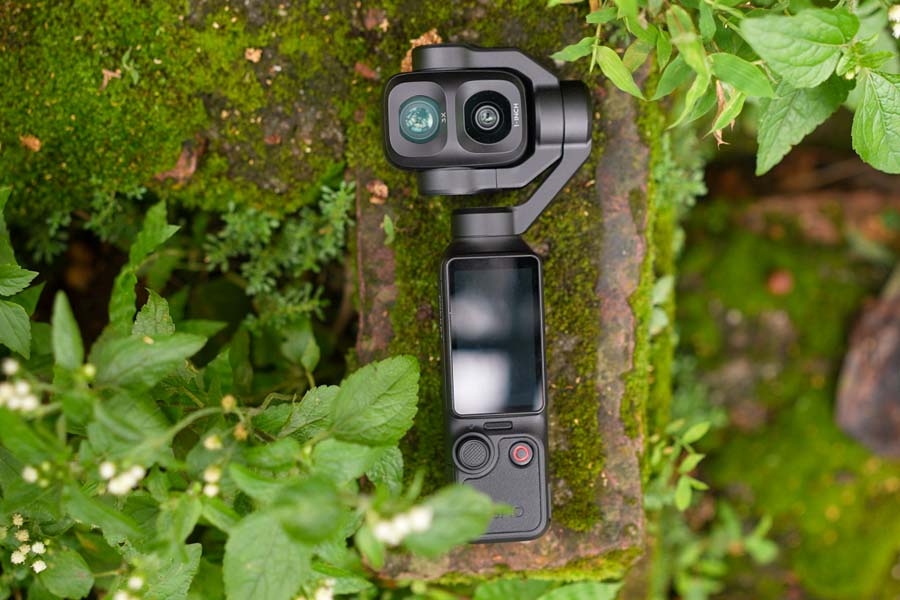
But if I had to choose one specifically for shooting video, I would buy the DJI Pocket 4P. It may not have Luna Ultra’s 8K headline spec or the iPhone’s all-in-one convenience, but its sharp 3× camera, excellent gimbal, strong low-light performance, reliable tracking and mature controls make it the most dependable run-and-gun camera of the three. For the price, I think it gives the best overall balance.
For more details, watch our full DJI Pocket 4P review video.
Article Last updated: October 26, 2026