History:
Bitcoin came into existence in 2009 with the need for a secure and transparent transaction system. When people transacted money over the internet, they go through some centralized system like Banks and they used to take a fair amount of the money for the transaction. If the transaction was international it could take days and cost more. Also, you had to completely trust the bank for your security which stored all your transaction details.
How do Bitcoins work?
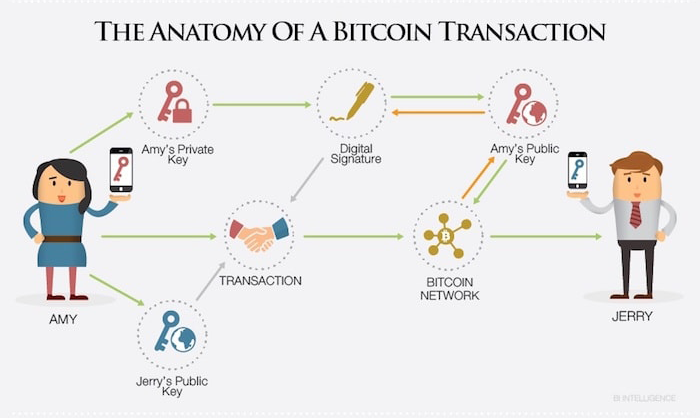
Bitcoin users peer-to-peer network which is same as how Bit-Torrents work. Bitcoin isn’t controlled by any central authority, it’s a community managed network. Trading Bitcoin, on the surface, is as simple as sending text over the internet, but the underlying crypto measures make it much safer, faster and efficient. An individual's Bitcoins are stored in Bitcoin wallet, and anyone having hold of the Bitcoin wallet has a private key which is kept secret. That key is used to sign/encrypt the transaction. For every transaction, the users have a unique public address which is just a random hash. One can have as many addresses as they want and it’s always a good thing to change addresses for different transactions to maintain anonymity. When a transaction is initiated, the sender creates a packet of data which has the sender's public address, amount sent and the receiver's public address. The packet is encrypted by the sender's private key which signs the packet with a digital signature(different every time and adds a mathematical problem to it. When a packet is sent, it is broadcasted to the Bitcoin network. The Bitcoin network is full of Miners who manages the Blockchain.
Blockchain: Public Ledger that keeps the record of all the bitcoin transactions. Miners: People who verify the entry in the blockchain. The package needs to be verified first by the Miners to get through the network to the receiving end. This includes checking of the
transaction standard and solving mathematical problems attached to the packet. After the transaction is verified and done, then the transaction record is saved as a block of data in the block chain. It takes an average of 10 mins to verify the transaction. The Blockchain doesn’t contain cumulative transaction record of a single public address. It just has the record of each transaction. Bitcoin is divisible. You can divide a single bitcoin into multiple pieces and use them separately.
Example: If you have one Bitcoin which is worth Rs.10,000 and you need to pay for a USB Drive that is Rs.3,000. Then you can break the single bitcoin and take Rs.3,000 out of it to pay for the USB Drive.